
Imagine walking into a library where the books are constantly being rewritten by thousands of people at once. You need to know exactly what is written on every page to trust the story. That is essentially what a blockchain node does when it joins a network. It has to download, verify, and align its local copy of the ledger with the rest of the world. This process is called node synchronization, and it is the hidden engine that keeps decentralized networks like Bitcoin and Ethereum secure and consistent.
If you have ever tried to run your own node, you know this isn't instant. It can take days. But why? And how do these computers agree on the truth without a central boss telling them what to do? Let's break down the mechanics of how nodes catch up, the different methods they use, and why getting this right matters for the entire ecosystem.
What Is Node Synchronization?
At its core, blockchain node synchronization is the process by which a node connects to the peer-to-peer network, downloads historical data, validates every transaction against consensus rules, and updates its local state to match the current network reality. When Satoshi Nakamoto launched Bitcoin in 2009, this mechanism was established as the foundation of decentralized trust. There is no central server to query for the "correct" balance. Instead, every participant must independently verify the history.
According to research from CSIRO (2022), synchronization guarantees that a node can securely participate in the network, validate new transactions, and serve accurate data to applications relying on it. Without this process, the network would fragment into conflicting versions of history. The goal is a single source of truth agreed upon by all participants.
The Step-by-Step Sync Process
When you start a new full node, here is what happens under the hood:
- Peer Discovery: The node connects to other peers via P2P protocols. It exchanges "inventory messages" to figure out how many blocks it is missing. Think of this as asking neighbors, "How far along are you? I'm just starting."
- Genesis Block Loading: Every node starts with Block #0, the genesis block. This data is hardcoded into the software itself, so it doesn't need to be downloaded.
- Block Downloading: The node requests blocks sequentially from the genesis block up to the latest one. For Bitcoin, this means downloading over 800,000 blocks as of late 2023.
- Validation: This is the heavy lifting. The node checks every transaction signature, ensures no double-spending occurred, and verifies that each block follows the consensus rules (like proof-of-work or proof-of-stake requirements).
- State Update: Once validated, the node updates its local database to reflect the current state of accounts and balances.
For established chains, this involves processing hundreds of gigabytes of data. NOWNodes notes that this process ensures network-wide consistency and security by guaranteeing all nodes maintain an identical copy of the distributed ledger.
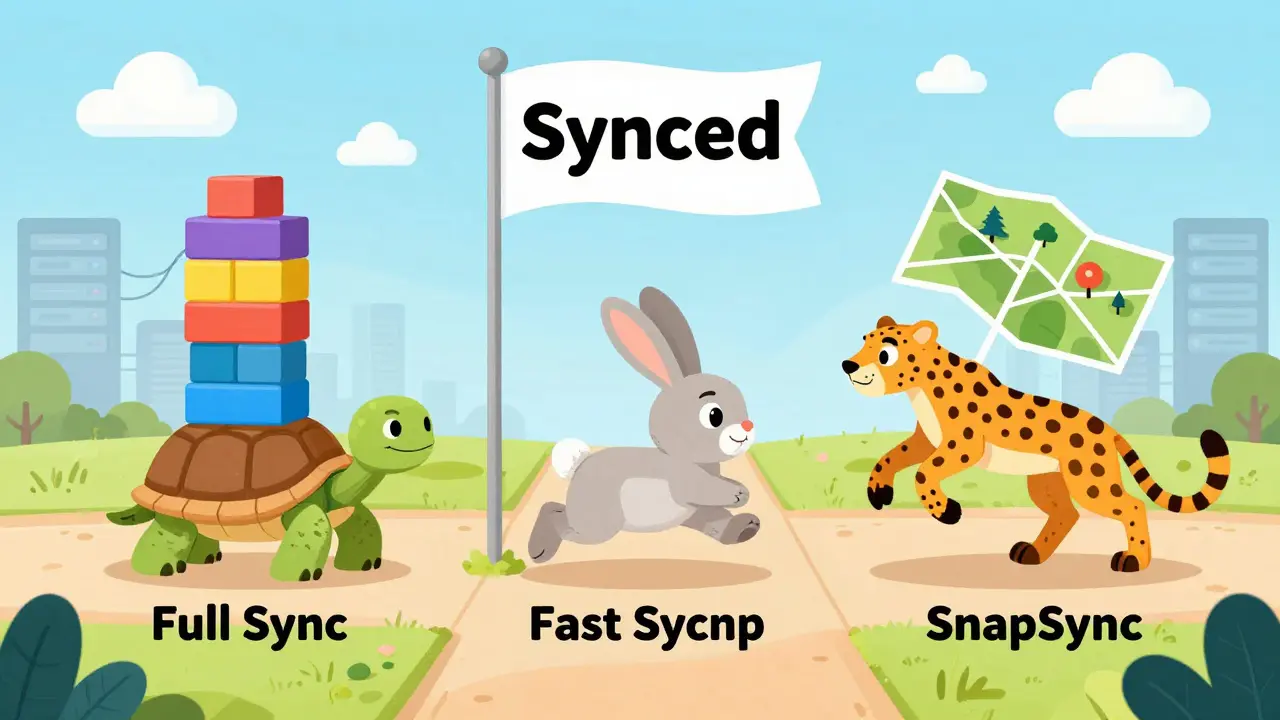
Full Sync vs. Fast Sync vs. Snap Sync
Not all synchronization is created equal. Depending on your hardware, time constraints, and security needs, you might choose different methods. Here is how they compare:
| Method | Time Required | Storage Needed | Security Level | Best For |
|---|---|---|---|---|
| Full Sync | 7-14 days (Ethereum) | 500GB+ (Bitcoin) | Highest (verifies all history) | Maximalists, long-term holders |
| Fast Sync | 12-48 hours | Moderate | Medium (trusts recent headers) | Developers needing quick access |
| Snap Sync | <4 hours | Low (recent state only) | Lower (relies on snapshots) | Testnets, light clients |
Full Sync is the gold standard. It downloads and validates every block from day one. As Contabo (2023) points out, this provides maximum security but demands significant resources. If you want to truly support decentralization, this is the way to go.
Fast Sync takes a shortcut. It downloads only recent block headers and state data, skipping the deep historical verification until later. MoonPay’s guide (2023) highlights that this reduces sync time dramatically but sacrifices some immediate historical verification capabilities. You are trusting that the recent validators haven't lied about the past.
Snap Sync is the newest optimization. Detailed by CSIRO (2022), it allows nodes to bootstrap using a recent snapshot of the blockchain state. For Ethereum, this often means syncing only the last 64,000 blocks. It’s incredibly fast-under four hours-but creates potential vulnerabilities if the snapshot source is compromised. Fuze.finance (2023) notes that enterprise apps usually require full sync, while test environments might use lighter methods.

Hardware Requirements for Smooth Syncing
Your computer specs matter more than you think. Trying to sync a mainnet node on a laptop with a spinning hard drive is a recipe for frustration. Based on community metrics and expert recommendations, here is what you need for a smooth experience:
- Disk I/O: Use an SSD, preferably NVMe. Ethereum processes over 100 million state entries. A traditional HDD will choke on the random read/write operations required during validation.
- CPU: An 8-core processor or better is recommended for mainnet synchronization. Validation is CPU-intensive.
- RAM: At least 32GB is advised for Ethereum. Increasing the database cache size (to 4GB minimum) can significantly speed up the process.
- Bandwidth: Minimum 100 Mbps internet connection. You are downloading huge amounts of data.
Reddit user 'NodeOperator87' reported that syncing an Ethereum mainnet full node on a high-end setup (1TB NVMe SSD, 32GB RAM) still took 9 days and 7 hours, with validation consuming 78% of that time. So even with great hardware, patience is key.
Common Pitfalls and Troubleshooting
Syncing isn't always smooth sailing. Developers frequently encounter errors. Here are the most common issues and how to fix them:
State Trie Verification Failures: According to Chainstack’s Q2 2023 Developer Report, this occurs in roughly 15% of Ethereum full sync attempts. This usually means the node got confused about account balances. The fix? Increase your database cache and ensure you have stable peer connections (12+ peers recommended).
Database Corruption: GitHub issue #2847 on Bitcoin Core highlights that database corruption happens in about 8.3% of sync attempts, often due to power loss or crashes during critical validation phases. Always use a UPS (Uninterruptible Power Supply) if possible.
Peer Disconnections: If your node loses contact with peers during sync, it may stall. Maintaining multiple peer connections helps mitigate this. Tools like Erigon’s state-sync protocol can reduce verification time by 65% compared to standard Geth implementations, helping avoid these bottlenecks.
Dr. Andreas Antonopoulos warns in 'Mastering Bitcoin' (2022) that improperly synchronized nodes represent a major security vulnerability. They can enable partition attacks or propagate invalid states. Never ignore sync errors.
Why Synchronization Matters for Network Health
You might wonder, "Why should I care if my node is slow?" The answer lies in decentralization. Glassnode analytics show that networks with faster average sync times (under 48 hours) demonstrate 32% higher transaction finality rates and 41% fewer orphaned blocks. Slow nodes mean a smaller number of participants can keep up, leading to centralization among those with expensive hardware.
Institutional adoption is driving this trend. Gartner’s 2023 report notes that 73% of Fortune 500 companies now operate at least one blockchain node. With the EU’s MiCA framework requiring financial institutions to maintain nodes with no more than 15 minutes of lag, efficient synchronization is becoming a regulatory necessity, not just a technical preference.
Future Improvements: Verkle Trees and Parallel Sync
The good news is that technology is catching up. Ethereum’s upcoming 'Verkle Trees' upgrade (scheduled for Q2 2024) promises to reduce full sync times from days to under 4 hours by optimizing how state data is represented. This is detailed in Ethereum Improvement Proposal 6800.
Parallel synchronization techniques, pioneered by the Erigon client, allow multi-threaded block processing. Benchmarks from the Ethereum Cat Herders group (October 2023) show this achieves 3.2x faster sync speeds compared to traditional single-threaded approaches. Services like NOWNodes’ 'Instant Sync' provide pre-synced snapshots updated every 15 minutes, reducing initial setup to under 10 minutes.
However, challenges remain. Bitcoin’s blockchain grows by approximately 144 MB per day. Without protocol-level optimizations, MIT researchers warn that full node synchronization may become prohibitively resource-intensive for standard hardware within 5-7 years. Innovations in state pruning and parallel processing are essential to keeping the network accessible to everyone.
How long does it take to sync a Bitcoin node?
Syncing a Bitcoin full node typically takes between 3 to 7 days depending on your hardware. Factors include disk speed (SSD is mandatory), CPU cores, and internet bandwidth. As of late 2023, the blockchain exceeds 400GB, so storage space is also a critical factor.
What is the difference between full sync and snap sync?
Full sync validates every block from the genesis block to the present, offering maximum security but taking days. Snap sync downloads a recent snapshot of the blockchain state and only validates the most recent blocks (e.g., last 64,000 for Ethereum). Snap sync is much faster (hours) but relies on trusting the snapshot source.
Do I need an SSD to run a blockchain node?
Yes, absolutely. Blockchain nodes perform millions of random read/write operations during validation. A traditional HDD will severely bottleneck the process, potentially causing sync failures or extreme delays. An NVMe SSD is highly recommended for optimal performance.
Why is node synchronization important for security?
Synchronization ensures that every node agrees on the same version of the ledger. Without proper sync, nodes might accept invalid transactions or fall behind, making the network vulnerable to partition attacks or double-spending. It maintains the decentralized trust model.
Can I sync a node on a cloud server?
Yes, many developers use cloud providers like AWS or Azure. However, ensure you select instances with high IOPS (Input/Output Operations Per Second) storage and sufficient CPU/RAM. Cloud storage costs can add up quickly given the large size of blockchain data (500GB+ for Bitcoin/Ethereum).
