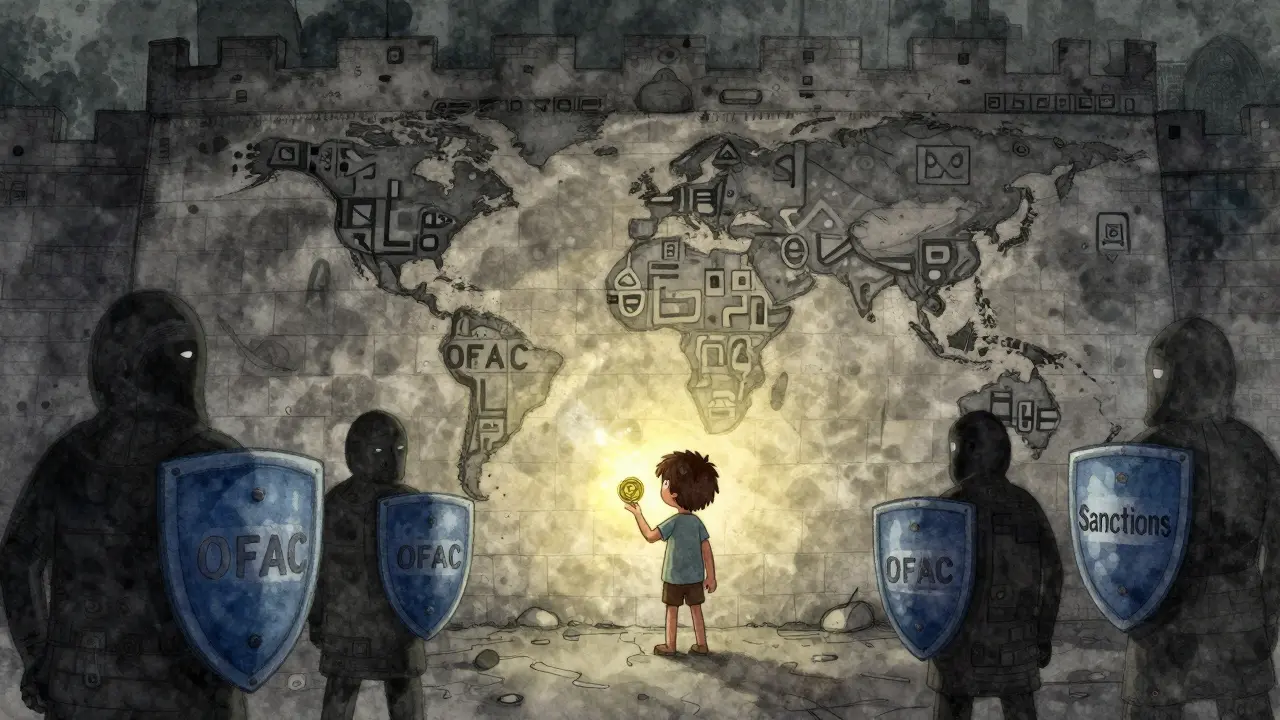
Trying to trade cryptocurrency in Iran today is less about finding a 'banned' list and more about navigating a minefield of international sanctions and domestic crackdowns. If you are looking for a simple chart showing which global platforms like Binance or Coinbase have pulled the plug on Iranian users, the answer is almost all of them. But the reality on the ground in Tehran is far more complex. It involves a tangled web of US Treasury mandates, aggressive blocking by stablecoin issuers like Tether, and a shifting local regulatory environment that oscillates between tolerance and total prohibition.
The landscape changed dramatically in late 2024 and throughout 2025. What used to be a gray area of relative freedom has hardened into a two-pronged restriction system. On one side, you have international entities cutting off access due to fear of secondary sanctions. On the other, you have the Iranian government imposing its own strict controls, including API mandates and stablecoin caps. For anyone holding assets or trying to move money in or out of the country, understanding these layers is critical to avoiding frozen funds.
The International Blockade: Why Global Exchanges Won't Touch Iran
The primary reason most major cryptocurrency exchanges do not serve Iranian residents is not because of a specific Iranian law banning those platforms, but because of United States sanctions. The US Treasury's Office of Foreign Assets Control (OFAC) maintains strict prohibitions against providing financial services to individuals and entities in Iran. For any exchange that holds US licenses, processes dollars, or wants to maintain banking relationships in Western jurisdictions, serving Iranian customers is an existential risk.
This means that while you won't find an official press release from every single exchange listing "Iran" as a banned country, their Terms of Service universally exclude sanctioned jurisdictions. Major centralized exchanges like Binance, Coinbase, and Kraken strictly enforce Know Your Customer (KYC) rules that flag and block Iranian IP addresses and identification documents. Attempting to bypass these checks using VPNs or foreign IDs often leads to immediate account suspension and asset freezing once discrepancies are detected.
The case of Bittrex serves as a stark warning. Before it filed for bankruptcy, Bittrex was forced to freeze accounts belonging to Iranian users following pressure from US authorities. One user, Ghader, attempted to sue for $88 million after being locked out during market rallies, but courts dismissed the case. The legal precedent is clear: exchanges reserve the right to suspend accounts for compliance reasons without liability. This creates a high-risk environment where your funds can vanish overnight if your location is flagged.
| Entity Type | Action Taken | Reason | Consequence for Users |
|---|---|---|---|
| Global CEXs (e.g., Binance, Coinbase) |
Account Blocking / KYC Rejection | OFAC Compliance | Inability to create new accounts; existing accounts frozen if flagged. |
| Tether (USDT) | Wallet Freezing | Sanctioned Address Linkage | Assets locked indefinitely; inability to transfer or cash out. |
| Payment Processors | Transaction Declines | Risk Mitigation | Fiat-to-crypto ramps blocked for Iranian bank cards. |
The Tether Freeze: A Turning Point for Stablecoins
If there is one entity that has caused the most panic among Iranian crypto users recently, it is Tether. As the issuer of USDT, the world's most popular stablecoin, Tether has increasingly cooperated with US sanctions enforcement. In July 2025, Tether executed its largest-ever freeze of Iranian-linked funds, targeting 42 specific cryptocurrency addresses. More than half of these addresses had substantial transactional exposure to Nobitex, Iran's largest domestic exchange.
This wasn't just a random sweep. The frozen wallets showed direct transaction flows to addresses previously flagged by the Israeli National Bureau for Counter Terrorist Financing and linked to the Islamic Revolutionary Guard Corps (IRGC). For ordinary users, this meant that simply trading on a local exchange could inadvertently link their wallet to a sanctioned network. Once flagged, the funds were immobilized.
The ripple effects were immediate. Reports from Tasnim News Agency, which is affiliated with the IRGC, indicated that thousands of Iranian accounts had been blocked. The message from Tether was clear: they will prioritize compliance with sanctioning regimes over user privacy. This forced a rapid shift in behavior among Iranian traders. Many began moving away from USDT, swapping into alternative stablecoins like DAI via decentralized networks such as Polygon to reduce the risk of centralized freezing.
Domestic Restrictions: The Central Bank's Tightening Grip
While international bans keep global exchanges at bay, the Iranian government has also moved to control the domestic crypto ecosystem. Historically, Iran had a relatively tolerant stance toward Bitcoin mining, viewing it as a way to monetize cheap energy. However, the policy shifted sharply in late 2024.
On December 27, 2024, the Central Bank of Iran implemented sweeping restrictions. They effectively blocked all cryptocurrency-to-rial and rial-to-cryptocurrency payments through internet websites within the country. This was a fundamental shift from passive monitoring to active restriction. The goal was to prevent capital flight and maintain control over the national currency.
However, the ban wasn't absolute. By January 2025, the Central Bank began selectively unblocking certain trader exchanges. The catch? These exchanges had to operate using the government's own API system. This API provides full access to user data, allowing the state to monitor every transaction. It creates a controlled environment where the government knows exactly who is buying what, ensuring that crypto cannot be used to evade broader economic sanctions or hide illicit wealth.
Furthermore, in February 2025, the regime launched a comprehensive ban on all cryptocurrency advertising, both online and offline. This attempt to limit adoption through information control makes it harder for new users to enter the market and stifles public discussion around digital assets.
Nobitex and the Local Exchange Landscape
With global options closed, many Iranians turned to local platforms, primarily Nobitex. As the largest domestic exchange, Nobitex became the de facto gateway for Iranian crypto trading. However, its prominence made it a target. The connection between Nobitex and the frozen Tether addresses highlighted the risks of relying on centralized local infrastructure.
Users faced a dilemma: stay on the local platform for ease of use and fiat conversion, or risk losing everything if the exchange itself became tainted by association with sanctioned entities. The July 2025 freezes disrupted entrenched transaction patterns, forcing users to diversify. Some moved to peer-to-peer (P2P) markets, while others explored decentralized finance (DeFi) protocols that do not require identity verification.
The Iranian government's approach to taxation also evolved. In August 2025, the enactment of the Law on Taxation of Speculation and Profiteering imposed a capital gains tax on cryptocurrency trading for the first time. By positioning crypto alongside gold and real estate, the state signaled its intent to formally regulate and extract revenue from digital asset markets, even as it restricted free movement.

Workarounds and Risks: Turkey and DeFi
Faced with dual pressures from Washington and Tehran, Iranian users have developed sophisticated workarounds. One key haven has become Turkey. With its large, dollarized crypto economy and flexible residency channels, Turkey serves as a gateway back into the financial system. Western governments have identified Turkish intermediaries as central players in sanctions evasion schemes, facilitating crypto transactions for Iranian users.
Another route is the rise of decentralized solutions. Since DeFi protocols operate on public blockchains without central authority, they are theoretically immune to traditional bans. Users can swap tokens, provide liquidity, and earn yields without ever interacting with a regulated exchange. However, this requires technical expertise and carries its own risks, such as smart contract vulnerabilities and impermanent loss.
Despite these alternatives, the risks remain high. The US Treasury intensified its efforts in 2024 to dismantle financial infrastructure sustaining sanctioned states, issuing 13 designations that included cryptocurrency addresses. Sanctioned jurisdictions accounted for a record 60% of total sanctions-related activity by value by the end of 2024. This means that even decentralized routes are under scrutiny, with chain analysis firms actively tracking suspicious flows.
Summary of Key Restrictions
- Global Exchanges: Effectively banned for Iranian users due to OFAC sanctions. Accounts are blocked or frozen upon detection.
- Tether (USDT): Actively freezes wallets linked to Iranian addresses or sanctioned entities, particularly those connected to Nobitex.
- Local Trading: Restricted to exchanges using the Central Bank's API, which grants the government full visibility into transactions.
- Stablecoin Limits: Individuals are capped at purchasing $5,000 annually and holding $10,000 in stablecoins.
- Advertising Ban: All crypto advertising is prohibited domestically, limiting public awareness and adoption.
Are all crypto exchanges banned in Iran?
Not explicitly by name in a single list, but functionally yes for most global platforms. Major exchanges like Binance and Coinbase block Iranian users due to US sanctions. Domestically, only exchanges integrated with the Central Bank's API are allowed to operate, creating a highly restricted environment.
Why did Tether freeze Iranian wallets?
Is it safe to use Nobitex?
Using Nobitex carries significant risk. While it is the largest local exchange, its connections to frozen Tether addresses and potential links to sanctioned entities mean that user funds could be frozen if the exchange itself comes under international pressure. Additionally, the government monitors all transactions through its API.
What are the limits on holding stablecoins in Iran?
As of September 2025, the Central Bank of Iran limits individuals to purchasing a maximum of $5,000 worth of stablecoins per year and holding no more than $10,000 in their balance at any time. These restrictions aim to curb capital flight and maintain control over the currency.
Can I use a VPN to access global exchanges?
Technically possible, but extremely risky. Exchanges use advanced KYC (Know Your Customer) procedures, including ID verification and facial recognition. If your identity is revealed as Iranian, your account will likely be suspended, and your funds may be frozen permanently due to sanctions compliance.
How does Turkey fit into the Iranian crypto scene?
Turkey has emerged as a key haven for Iranian users seeking to circumvent restrictions. Its large crypto economy and flexible residency options make it a gateway for accessing global financial systems. However, this activity is closely monitored by Western governments as part of sanctions evasion efforts.

9 Comments
mark valmart
May 31, 2026 AT 10:48 AMman this whole situation is just a mess for regular folks trying to save money. its crazy how the big players like tether can just freeze your assets if they feel like it or if some government tells them to. i guess that's why everyone is talking about defi now, even though its super risky and hard to use. you basically have to trust code instead of people, which is also scary in its own way.
kamal ifrani
May 31, 2026 AT 14:29 PMyou guys are missing the point entirely. this isn't about 'regular folks' saving money, it's about sanctions evasion and funding terrorist organizations like the IRGC. the article clearly states that nobitex was linked to addresses flagged by counter-terrorist financing bureaus. so yes, tether freezing those wallets is morally justified and legally required. stop acting like victims when you're part of a sanctioned economy trying to break international law. it's disgusting how people here try to spin this as oppression when it's actually compliance with global security standards. the us treasury did their job right.
saradee dee
June 2, 2026 AT 01:49 AMoh my god kamal please calm down. nobody said anything about terrorism being okay. but imagine being an innocent trader who just wanted to buy bitcoin because the rial was crashing and you needed to protect your savings. suddenly your life savings are gone because you used a local exchange that had one bad connection somewhere in the chain. it feels so unfair and terrifying. i think we should all be more empathetic towards people living under such strict controls. it must be awful to not know if your money will still be there tomorrow.
Craig Swanson
June 2, 2026 AT 18:41 PMlisten up saradee you need to wake up to reality. empathy is great but ignorance is dangerous. these aren't just 'innocent traders'. the data shows direct flows to sanctioned entities. if you're trading on nobitex you're either knowingly supporting that network or you're incredibly naive. either way you're part of the problem. the system works exactly as intended to cut off funding streams. don't come here crying about feelings when the evidence is clear. get educated before you start preaching about victimhood.
Bill Gunn
June 4, 2026 AT 16:17 PMwhoa there craig let's keep it civil 🙄. look at the bigger picture here. the shift to polygon and dai is fascinating from a tech standpoint. it shows how resilient crypto communities are even under extreme pressure. people are finding ways to use decentralized protocols to bypass centralized control points. sure there are risks like smart contract bugs but the innovation happening in response to these restrictions is wild. maybe we can learn something from how they adapt to survive 😎.
stalin brian
June 5, 2026 AT 02:36 AMi mean yeah bill makes a good point about the tech side of things. its kinda cool how they use polygon to swap tokens without getting caught by the usual kyc checks. but its also super risky if you dont know what ur doing. one wrong click and u lose everything. i wonder if there are any tutorials out there for beginners trying to do this safely? seems like a steep learning curve for someone who just wants to trade.
Hadleigh Edwards
June 6, 2026 AT 20:34 PMwell when you really think about it the entire concept of digital currency was supposed to liberate people from traditional banking systems and government interference but now we see that governments are fighting back harder than ever before using every tool at their disposal including advanced blockchain analysis firms that track transactions across different chains which means that even the most sophisticated workarounds involving decentralized finance protocols and alternative stablecoins might eventually be traced back to the original user through complex pattern recognition algorithms developed by private companies working with state agencies so the dream of true financial anonymity is probably dead anyway.
Diana Morris
June 7, 2026 AT 20:11 PMstop making excuses for sanctions evasion. turkey is becoming a hub for illegal crypto activity because of this. western governments are watching closely. if you think moving funds through istanbul makes you safe you are wrong. the net is closing in. deal with it.
Dana Rapoport
June 8, 2026 AT 02:50 AMthe philosophical question here is whether privacy is a fundamental human right or a privilege granted by the state. when the state restricts access to financial tools does it violate individual autonomy? the central bank api mandate essentially turns every transaction into a surveillance event. it changes the nature of ownership itself.