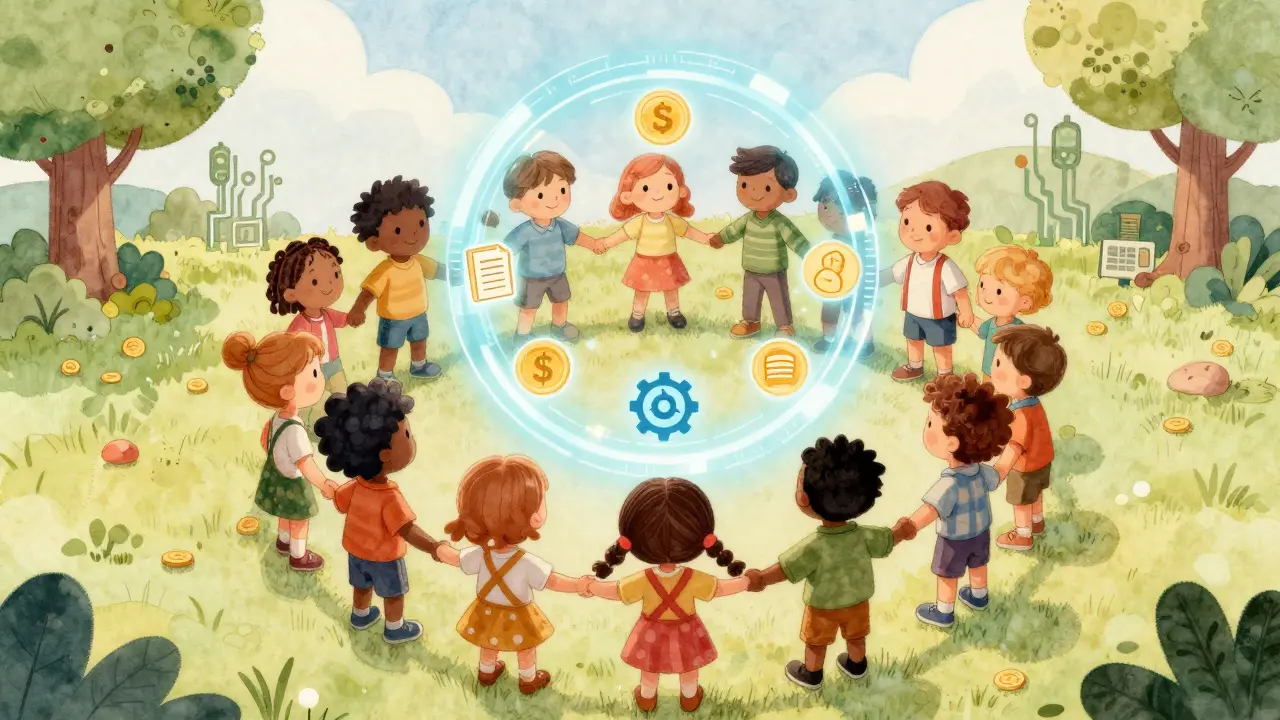
Imagine buying a copy of the US Constitution for $43 million. Now imagine doing it with 17,000 strangers you’ve never met, pooling your money in real-time via crypto wallets, and voting on every move as a group. That’s not a sci-fi plot; that was ConstitutionDAO, a decentralized autonomous organization formed in July 2021 to bid on a rare historical document at Sotheby's auction house. They raised $47 million in just 72 hours. Did they win? No. But the experiment revealed everything we need to know about what works-and what breaks-in the world of Decentralized Autonomous Organizations (DAOs).
DAOs are more than just buzzwords from the 2021 bull run. They represent a fundamental shift in how humans organize, collaborate, and manage value without traditional hierarchies. As of late 2023, there were over 11,000 active DAOs managing billions in assets. Yet, most people still don’t understand how they actually function or why some thrive while others collapse into chaos.
This article cuts through the noise. We’ll look at famous DAO examples across different sectors-finance, art, social communities, and philanthropy-to see how they operate, where they fail, and what lessons you can apply whether you’re an investor, a developer, or just curious about the future of work.
What Is a DAO, Really?
Before diving into case studies, let’s strip away the jargon. A Decentralized Autonomous Organization (DAO) is an internet-native business owned and managed by its members, operating through smart contracts on a blockchain rather than corporate legal structures. Think of it like a cooperative, but instead of a board of directors making decisions behind closed doors, every member holds a token that gives them voting power. Rules are written in code (smart contracts), and treasury funds are locked until the community votes to release them.
The key difference between a DAO and a traditional company is transparency and control. In a corporation, you trust executives to act in your best interest. In a DAO, you verify transactions yourself. However, this freedom comes with complexity. You need a crypto wallet (like MetaMask), you need to understand governance proposals, and you need to care enough to vote. If you don’t participate, you have no say.
DeFi DAOs: The Powerhouses of Protocol Governance
Decentralized Finance (DeFi) protocols make up the largest chunk of the DAO ecosystem, accounting for roughly 32% of all DAOs. These aren’t just communities; they are financial infrastructure. Two giants stand out here: Uniswap and Compound.
Uniswap is a leading decentralized exchange protocol that allows users to trade cryptocurrencies directly without intermediaries, governed by UNI token holders. Since launching in 2018, Uniswap has processed over $1.2 trillion in trading volume. It’s one of the most successful software projects in history, yet it has no CEO. Instead, UNI token holders vote on fee structures, treasury spending, and protocol upgrades. For example, passing a major change often requires 40 million "yes" votes-a high bar designed to ensure broad consensus.
But success brings problems. The biggest issue facing DeFi DAOs is voter apathy. According to Defiant’s 2023 analysis, average turnout for Compound governance proposals hovers around 3.2%. Why does this matter? Because when only a tiny fraction of token holders vote, the system becomes vulnerable to manipulation by whales (large holders). This concentration of power contradicts the democratic ideal of DAOs. Despite this, these protocols remain robust because their core code is battle-tested, even if their governance participation is low.
| DAO Name | Type | Total Value Locked (TVL) | Governance Challenge |
|---|---|---|---|
| Uniswap | Exchange | $5B+ | Low voter turnout (~3%) |
| Compound | Lending | $2.7B | Whale dominance in voting |
| MakerDAO | Stablecoin | $8B+ | Complex multi-token voting |
Investment DAOs: Democratizing Venture Capital
If DeFi DAOs manage money, Investment DAOs *make* money by investing in early-stage startups. The LAO (League of Autonomy) is one of the oldest and most prominent investment DAOs, founded in 2019 to pool capital from global members to invest in blockchain projects. By Q2 2023, The LAO had invested in 67 startups and held a treasury of $32 million.
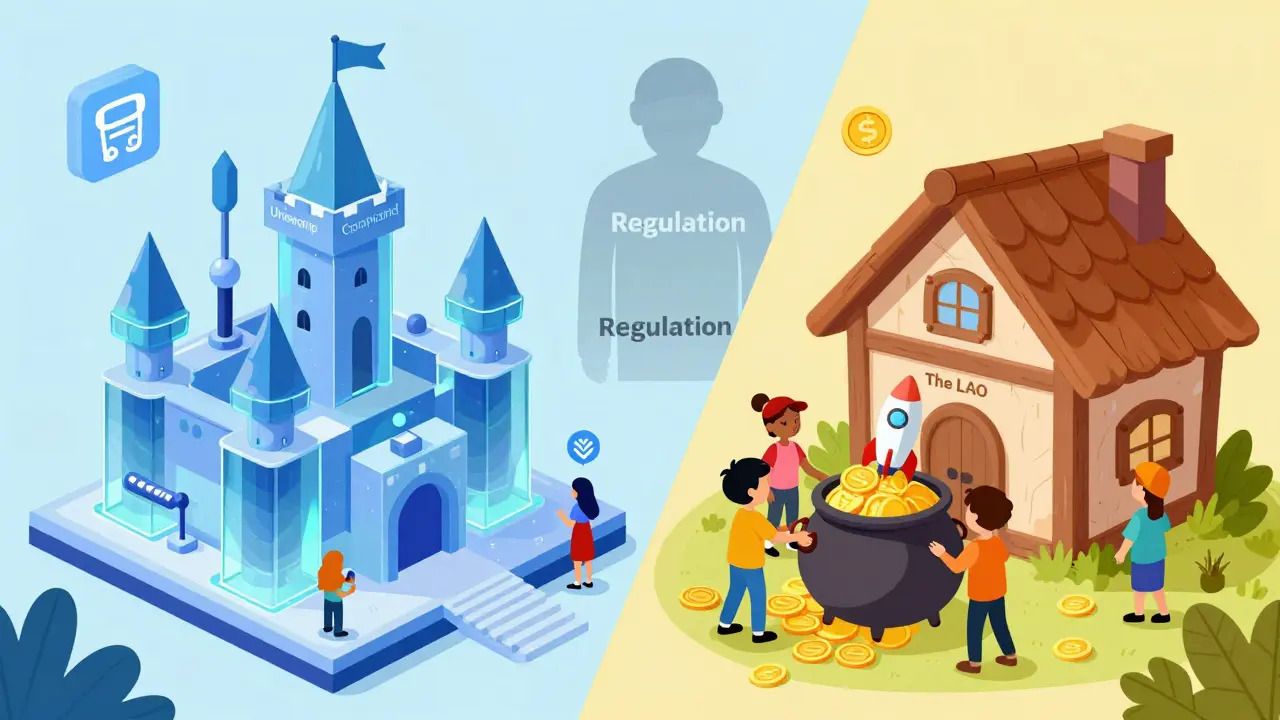
The appeal is obvious: access to venture capital deals usually reserved for accredited investors. However, The LAO faces a unique hurdle: regulation. To operate legally in the U.S., they wrapped their DAO inside a Delaware LLC. This hybrid model-on-chain voting combined with off-chain legal compliance-is becoming the standard for serious investment groups. Pure on-chain DAOs struggle to open bank accounts or sign contracts, which limits their ability to interact with the traditional economy.
Another notable example is Krause House DAO, a collector DAO that successfully raised $4.2 million to purchase a minor league basketball team, demonstrating real-world asset acquisition capabilities. Unlike typical NFT collectors who buy digital art, Krause House bought a physical business. This proved that DAOs could handle complex legal entities and tangible assets, not just tokens.
Social and Philanthropy DAOs: Community First
Not all DAOs are about profit. Some are built purely for connection or good causes. Friends With Benefits (FWB) is a large social DAO with over 12,000 members focused on building relationships and collaboration among builders in the Web3 space. Membership costs a one-time payment, and there’s no equity stake. It’s essentially a digital country club. While FWB struggles with monetization beyond membership fees, it excels at network effects. Members find jobs, co-founders, and partners within the community.
On the charitable side, Giveth is a philanthropy platform and DAO that facilitates transparent donations, having distributed over $47 million since 2017. Traditional charities often lose public trust due to opaque fund allocation. Giveth solves this by putting every donation on the blockchain. Donors can track exactly where their money goes. However, they face the challenge of cryptocurrency volatility-if ETH drops 20% overnight, the purchasing power of their treasury shrinks instantly.
Failure Cases: What Goes Wrong?
To understand DAOs, you must study their failures. The first major DAO, simply called "The DAO," launched in 2016. It raised $150 million but was hacked weeks later due to a vulnerability in its code. The Ethereum network had to split (hard fork) to recover the funds, creating Ethereum Classic in the process. This event taught the industry a hard lesson: code is law, but bad code is catastrophic.
More recently, PleasrDAO attempted to buy a Wu-Tang Clan album for $4 million. They raised the funds, but internal governance disputes stalled the deal. The seller walked away, and the DAO refunded members. This highlighted a critical weakness: DAOs are slow. Corporate decisions take hours; DAO proposals take 7-14 days. In fast-moving markets, speed matters.
Security remains the biggest risk. Chainalysis reported $1.3 billion lost to DAO-related exploits between 2021 and 2023. Most hacks happen not because of malicious intent, but because of human error in smart contract coding or phishing attacks targeting key signers.
How to Participate in a DAO
If you want to join a DAO, you don’t need a computer science degree, but you do need patience. Here’s the basic path:
- Set up a wallet: Download MetaMask or Rabby Wallet. Secure your seed phrase offline.
- Buy tokens: Most DAOs require holding their native governance token (e.g., UNI, COMP, GIV). Buy these on exchanges like Coinbase or Kraken.
- Join the community: Go to Discord or Telegram. Read the docs. Listen before speaking.
- Start small: Vote on low-stakes proposals. Join working groups. Build reputation.
- Delegate if needed: If you’re busy, delegate your voting power to trusted experts using platforms like Snapshot.
The learning curve is steep. Gitcoin’s 2023 survey found it takes 8-12 weeks to become an effective contributor. But the reward is direct ownership in the tools and communities shaping the future of the internet.
The Future: Hybrid Models and Legal Clarity
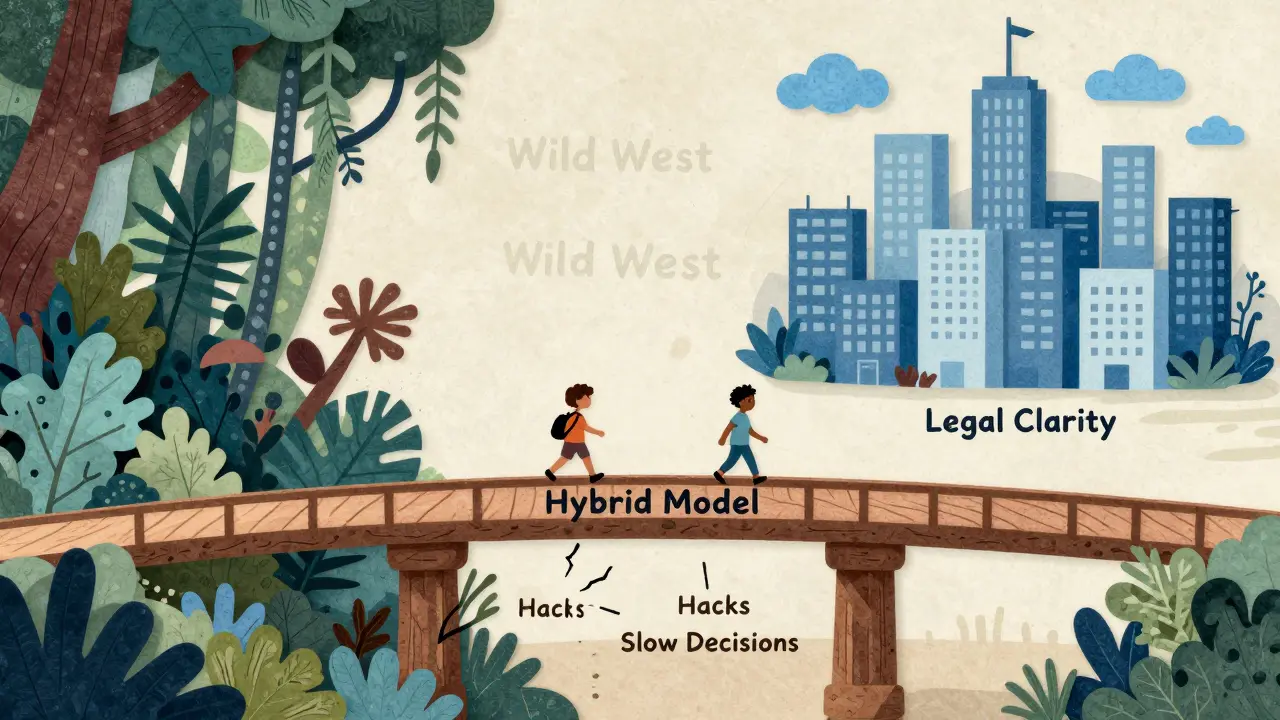
Where do DAOs go from here? Pure decentralization is hitting walls. The most successful DAOs are adopting hybrid models-combining on-chain transparency with off-chain legal wrappers (like Wyoming LLCs). This gives them liability protection and banking access while keeping governance decentralized.
Regulatory clarity is also improving. States like Wyoming, Tennessee, and Utah now recognize DAOs as legal entities. Meanwhile, enterprise adoption is growing; Deloitte reports 63% of Fortune 500 companies are experimenting with DAO structures for specific projects. The technology is maturing, moving from wild west experiments to structured organizational tools.
Are DAOs legal in my country?
It depends. Only a few U.S. states (Wyoming, Tennessee, Utah) have explicit laws recognizing DAOs as legal entities. In many other jurisdictions, DAOs exist in a gray area, potentially exposing founders to personal liability. Always consult a local attorney before forming or joining a DAO with significant financial stakes.
How much money do I need to start participating in a DAO?
Very little. You can join social DAOs for free or for a small membership fee. For governance participation, you need to hold the DAO’s token, which can cost anywhere from $1 to thousands depending on the project. Many DAOs allow you to delegate your vote if you hold tokens but don’t want to vote yourself.
Can a DAO be hacked?
Yes. Smart contracts can have vulnerabilities, and human operators can be phished. Between 2021 and 2023, over $1.3 billion was lost to DAO-related exploits. Reputable DAOs undergo rigorous third-party audits and use multi-signature wallets to reduce risk, but zero risk does not exist in crypto.
Why do some DAOs fail?
Common reasons include unclear governance rules, low voter participation (apathy), security breaches, and inability to interface with traditional legal systems. Social DAOs often fail due to lack of clear purpose or monetization strategy, while investment DAOs struggle with regulatory compliance.
What is the difference between a DAO and a traditional company?
Traditional companies have hierarchical management (CEO, board) and centralized decision-making. DAOs are flat organizations where decisions are made collectively by token holders via smart contracts. DAOs offer greater transparency and borderless participation but suffer from slower decision-making and complex onboarding.
