
Imagine showing your university degree to a potential employer. In the old world, you’d mail a physical transcript or log into a clunky portal to request verification. Now, picture sending a single file that proves your graduation instantly, without calling the registrar’s office. That is exactly what NFT verified credentials do.
This isn't just about trading digital art anymore. We are seeing a massive shift where Non-Fungible Tokens (NFTs) act as secure containers for real-world achievements. From professional certifications to academic degrees, these tokens store data in a way that is tamper-proof and universally verifiable. But how does this actually work under the hood? It turns out it’s less about the image on the token and more about the cryptographic links hidden inside the code.
The Shift from Collectibles to Credentials
When most people think of NFTs, they think of JPEGs selling for millions. But since 2020, developers have been repurposing this technology for something far more practical: identity and verification. According to Rapid Innovation's analysis, this represents a major evolution. We are moving away from NFTs as mere collectibles toward using them as tools for self-sovereign identity.
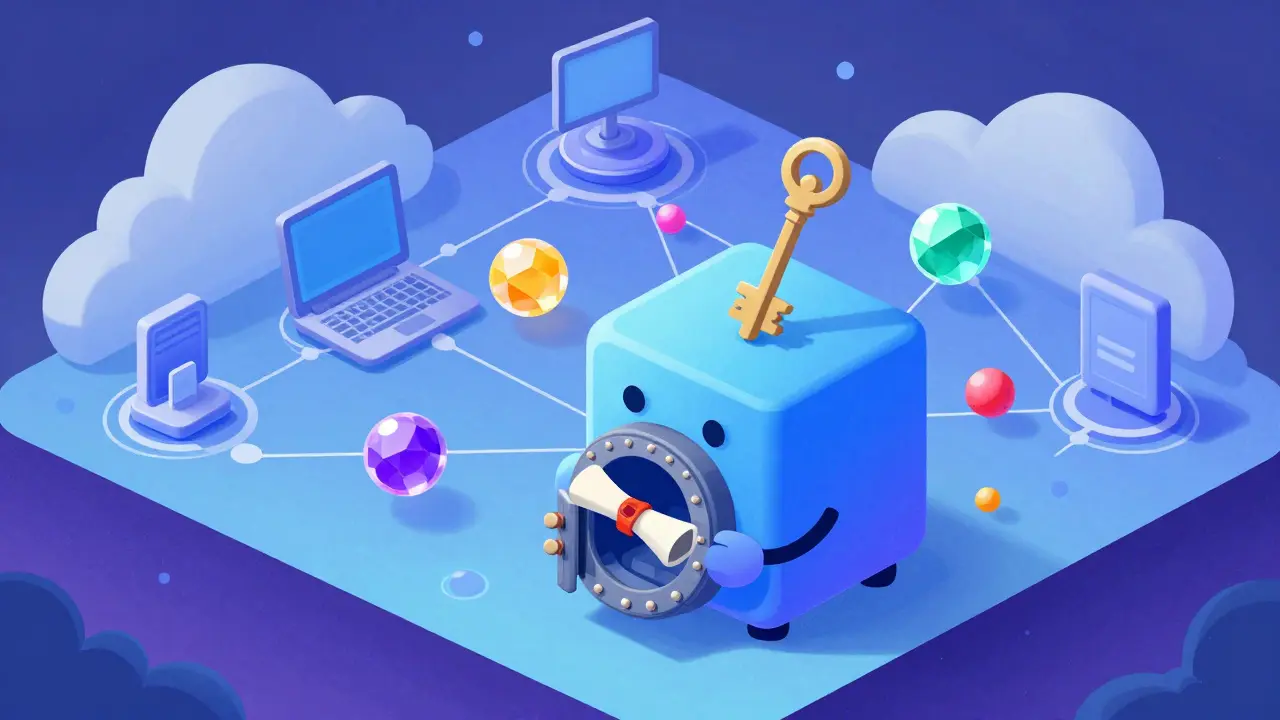
Here is the core idea: an NFT is a unique digital asset owned by you. If we attach a credential-like a diploma-to that asset, you control it forever. No school can revoke it arbitrarily, and no central database can go down and hide your record. ArcBlock describes these as "digital artifacts" that let you prove claims about yourself without needing a middleman. This changes the power dynamic completely. You hold the key, not the institution.
Technical Foundations: How Data Lives on the Chain
To understand how this works, we need to look at the technical stack. The process relies on three main components: the blockchain standard, the storage method, and the identity protocol.
Ethereum is the primary platform for NFT credentials, utilizing specific smart contract standards to define token behavior. The two most common standards are ERC-721 and ERC-1155.
- ERC-721: This standard creates completely unique tokens. If you get a PhD, your NFT is distinct from everyone else’s. It’s one-of-a-kind.
- ERC-1155: This allows for semi-fungible tokens. Think of a generic "First Aid Certified" badge. Many people have it, but each instance is still tracked individually. It’s more efficient for mass issuance.
But here is the catch: blockchains are expensive and slow at storing large amounts of text. You don’t want to pay gas fees to store your entire resume on-chain. So, how is the data stored?
Most systems use a hybrid approach. The actual credential data (your name, grade, date) is stored off-chain in decentralized storage solutions like IPFS (InterPlanetary File System) or Arweave. These platforms ensure the data remains accessible even if one server goes down. The blockchain only stores a "hash"-a unique cryptographic fingerprint-of that data. When a verifier checks your NFT, they compare the hash on the chain with the data in the file. If they match, the credential is valid. If someone tries to edit your GPA in the file, the hash changes, and the verification fails instantly.
Decentralized Identifiers (DIDs): Your Digital Passport
Storing the data is half the battle. The other half is proving who owns it. This is where Decentralized Identifiers (DIDs) come in. Unlike a username on Facebook, a DID is not controlled by any company.
When you set up an NFT wallet, it generates a DID based on your public-private key pair. For Ethereum users, this often looks like `did:ethr:...`. This identifier links to a "DID Document," which contains the cryptographic keys needed to verify signatures. Itexus notes that these documents can be stored on-chain via smart contracts like ERC-1056 or off-chain in decentralized storage.
Here is why this matters for privacy. When you share a credential, you aren't sending your personal data to a third party. Instead, you sign a cryptographic challenge with your private key. The verifier resolves your DID and confirms the signature matches the issuer’s public key. Zero-knowledge proofs (ZKPs) take this further, allowing you to prove you meet a requirement (e.g., "I am over 18") without revealing your actual birthdate.
Why NFTs Beat Traditional Verification
You might wonder why we need such complex tech when PDFs exist. The answer lies in trust and speed. Traditional verification is slow, expensive, and prone to fraud. A World Bank report cited by Credly Study showed that blockchain credentialing could cut verification time from weeks to seconds and reduce administrative costs by 60-75%.
| Feature | Traditional (PDF/Paper) | NFT-Based Credential |
|---|---|---|
| Verification Speed | Days to Weeks | Seconds |
| Fraud Resistance | Low (Easy to forge) | High (Cryptographically secured) |
| Data Control | Institution holds data | User holds data (Self-sovereign) |
| Portability | Tied to email/portal | Follows user across wallets/devices |
| Cost | High administrative overhead | Low marginal cost after setup |
For example, a student applying for jobs doesn’t need to wait for transcripts. They simply grant temporary access to their NFT. The employer verifies it on the Ethereum blockchain instantly. As Harvard Business Review noted in January 2024, smart contracts automate this enforcement, removing intermediaries entirely.
Real-World Challenges and User Friction
It sounds perfect, right? Not quite. The technology is powerful, but the user experience (UX) is still rough. Early implementations show a clear divide between technical capability and human usability.
Private key management is the biggest hurdle. If you lose your seed phrase, you lose your credentials. There is no "forgot password" button on the blockchain. Monperrus’s 2025 analysis highlighted that recovery mechanisms remain problematic. Reddit threads from r/BlockchainCredentials are filled with stories like, "I lost access to my degree NFT when I reset my phone." This is a critical flaw for mass adoption.
Then there is the issue of interoperability. An NFT issued on Ethereum might not be easily readable by a system built on Polygon or Solana. While cross-chain protocols are developing, we aren't there yet. Furthermore, employers and HR departments often lack the literacy to verify these assets. One user noted, "My employer's HR department doesn't understand how to verify my NFT certification." Until verification becomes as simple as scanning a QR code, friction will remain high.

Market Adoption and Future Outlook
Despite these hurdles, adoption is accelerating. The global digital credential market was valued at $2.3 billion in Q2 2025, with NFT-based solutions capturing 18.3% of that value. Academic institutions are leading the charge. EdTech Digest reported that 41 of the top 100 global universities had implemented NFT credential systems by September 2025.
Enterprise adoption is slower but growing. Deloitte found that 27% of Fortune 500 companies were piloting NFT-based professional certifications in 2025, up from just 8% in 2023. Regulatory bodies are also catching up. The European Blockchain Services Infrastructure (EBSI) established standards in early 2025, and the U.S. Department of Education launched a pilot for digital diplomas in April 2025.
Looking ahead, the focus is on improving usability. Ethereum’s upcoming Pectra upgrade (scheduled for Q1 2026) includes account abstraction features that should simplify key recovery. Gartner predicts that NFT credentials could become the standard for verification by 2030, provided usability improves significantly and institutional adoption hits 60%. Currently, we are at 22%, so there is still a long road ahead.
Conclusion: Is It Worth It Yet?
For now, NFT verified credentials are best suited for contexts where permanence and fraud resistance are critical, such as academic degrees or high-stakes professional licenses. For everyday tasks, traditional methods may still be easier. However, as wallets become more user-friendly and cross-chain standards solidify, this technology promises to give individuals true ownership of their digital identities. The future isn't just about owning art; it's about owning your history.
What is an NFT verified credential?
An NFT verified credential is a digital certificate (like a diploma or license) stored as a Non-Fungible Token on a blockchain. It uses cryptographic hashes to link the token to off-chain data, ensuring the credential cannot be forged or altered without detection.
Are NFT credentials safe from hacking?
The blockchain itself is highly secure and resistant to tampering. However, security depends heavily on user behavior. If you lose your private key or seed phrase, you lose access to your credentials permanently. Most compromises stem from user error rather than blockchain vulnerabilities.
Can I transfer my NFT credentials to another wallet?
Yes, because NFTs are assets you own, you can transfer them between wallets. However, most credential NFTs are designed to be non-transferable to prevent fraud, meaning they are bound to your specific DID (Decentralized Identifier) rather than being tradable like art.
Which blockchain standards are used for credentials?
The most common standards are ERC-721 for unique credentials and ERC-1155 for batch-issued credentials. These operate primarily on Ethereum and compatible EVM chains, though cross-chain bridges are emerging to support other networks.
Do employers accept NFT credentials?
Adoption is growing but not universal. As of 2025, many Fortune 500 companies are piloting verification systems, and dozens of top universities issue them. However, smaller organizations may still require traditional verification due to lack of technical infrastructure.
