
You create something original. A song, a logo, a piece of code, or a design. But weeks later, someone else publishes something nearly identical and claims they did it first. You know you didn't copy them. They know you didn't copy them. The problem? Neither of you has hard proof of who created what when. This is where timestamp verification becomes your most valuable asset in intellectual property (IP) disputes.
In the digital world, files are easy to copy and hard to trace back to their origin. Traditional copyright laws say you own your work the moment you create it, but proving that "moment" in court can be a nightmare. Timestamping solves this by creating an unchangeable, third-party verified record that says, "This specific file existed at this exact date and time." It doesn't grant you rights, but it proves you held those rights before anyone else could claim them.
How Timestamp Verification Actually Works
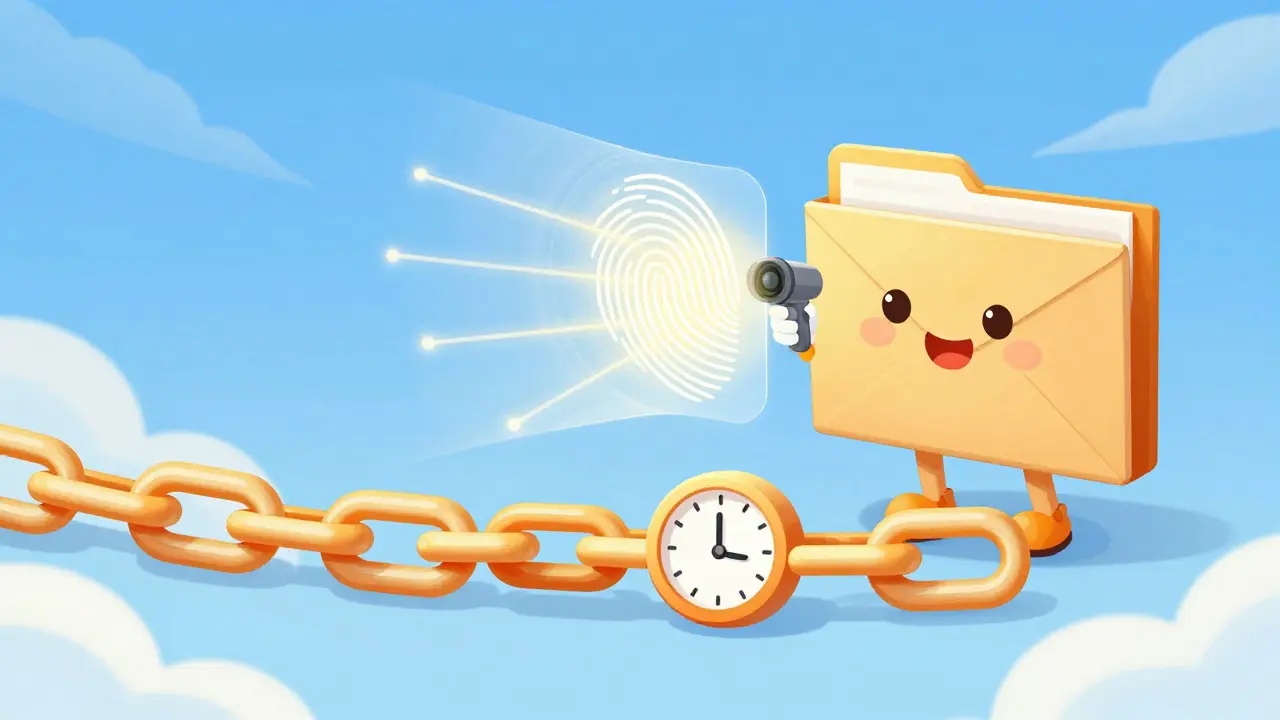
At its core, timestamp verification is about linking data to a specific point in time using cryptography. When you submit a file to a timestamping service, the system doesn't necessarily store your actual file. Instead, it creates a unique digital fingerprint, known as a hash, of your content. Think of a hash like a snowflake; no two files produce the same hash, and even changing one pixel in an image changes the entire hash.
The service then locks this hash into a secure record along with the current date and time from an authoritative source. This record is often anchored on a blockchain or signed by a qualified Timestamp Authority. Because blockchains are immutable, once that timestamp is written, it cannot be altered or deleted. If you need to prove ownership later, you re-hash your file and compare it to the original record. If the hashes match, you have mathematical proof that the file existed exactly as it is now, at the time stamped.
This process relies on several key entities:
- Digital Hash: A unique string of characters representing the file's content.
- Timestamp Authority: A trusted third party that issues the time stamp.
- Blockchain Ledger: The distributed database that stores the timestamp permanently.
The beauty of this system is that it works independently of the content itself. Whether you're protecting a PDF contract, a high-resolution photograph, or a software algorithm, the mechanism remains the same. You get a certificate that acts as a legal receipt for your creation date.
Why WIPO PROOF Changed the Game
For years, creators relied on informal methods like mailing themselves a copy of their work (the "poor man's copyright") or using private cloud storage dates. These methods were weak in court because they could be manipulated. In mid-2020, the World Intellectual Property Organization (WIPO) launched WIPO PROOF, a global service designed to fix this gap.
WIPO PROOF uses public key infrastructure to provide secure timestamps for digital files. It allows creators to obtain a unique token that records the critical date of existence. What makes WIPO PROOF special is its authority. It is not just another tech startup; it is backed by an intergovernmental organization dedicated to IP protection worldwide.
However, it is crucial to understand what WIPO PROOF does and does not do. It performs a formalistic function. Having a WIPO PROOF token does not confer IP rights per se. Copyright arises automatically upon creation. Patents require registration. WIPO PROFF simply provides an official document attesting to the date and time of existence. It is the "first in time" evidence. As WIPO states, it is a quick, inexpensive, and efficient first step to official confirmation.
If you are a freelancer, artist, or small business owner, WIPO PROOF offers a level of credibility that private services might struggle to match in international disputes. It bridges the gap between informal creation and formal legal enforcement.
Commercial Alternatives: KeeeX, Drawy, and eIDAS Compliance
While WIPO PROOF is the gold standard for international recognition, other commercial services offer robust solutions tailored to specific needs, particularly in Europe. Services like KeeeX and Drawy provide timestamping with varying levels of legal weight depending on your jurisdiction.
KeeeX, for example, offers multiple methodologies including system date timestamping, RFC 3161 standard-based timestamping, and qualified timestamping via the eIDAS regulation. The eIDAS (Electronic Identification, Authentication and Trust Services) regulation is vital for European users. Under eIDAS, a "qualified" timestamp has a presumption of legal validity in litigation across EU member states. This means courts must accept it as valid unless proven otherwise, shifting the burden of proof significantly.
Drawy takes a slightly different approach, focusing on design protection. When you upload a design to Drawy, it is sent to a Timestamp Authority that generates a unique timestamp. The result is a PDF document containing the date, time, owner details, and a unique deposit reference. This combination of file and timestamp creates a verifiable chain of custody.
| Service | Key Feature | Legal Framework | Best For |
|---|---|---|---|
| WIPO PROOF | Global recognition, UN-backed | International IP Law | Creators seeking worldwide credibility |
| KeeeX | Blockchain anchoring + eIDAS | eIDAS (EU), RFC 3161 | European businesses requiring court-admissible evidence |
| Drawy | Design-specific PDF certificates | Qualified Timestamp Authorities | Graphic designers and industrial design firms |
When choosing a service, consider where you plan to enforce your rights. If you operate globally, WIPO PROOF is a strong choice. If you are strictly within the EU and need immediate legal standing in court, a qualified eIDAS timestamp from KeeeX might be more practical. For designers who need a simple, visual proof of concept, Drawy's PDF output is highly effective.
Using Timestamps in Copyright and Patent Disputes
Copyright and patents serve different purposes, but both rely heavily on establishing priority. Copyright protects original works of authorship, while patents protect inventions. In both cases, being "first in time" is often the deciding factor in infringement lawsuits.
For copyright, the challenge is that protection is automatic. You don't register a poem to own it. But if someone sues you for plagiarism, you need to prove you wrote it before they published their version. A timestamped record from a trusted third party provides this proof. It shows that your file existed in its final form before the alleged infringer claimed it as theirs. This is especially powerful against "reverse plagiarism," where someone steals your idea and tries to claim they originated it.
For patents, the stakes are higher. While patent offices maintain their own records, the development phase before filing is vulnerable. Companies often use timestamping to protect trade secrets and R&D discoveries during the innovation lifecycle. By timestamping draft specifications, lab notes, and prototype designs, companies create a paper trail that demonstrates continuous development and prior art. This can be crucial if a competitor files a similar patent application shortly after leaking information from your team.
Consider this scenario: You are a software developer working on a new algorithm. You share your code with a potential investor under an NDA. Months later, the investor launches a competing product with similar code. Without a timestamp, you'd have to rely on email chains and witness testimony, which can be disputed. With a blockchain-anchored timestamp of your code repository from before the meeting, you have immutable proof of prior creation. This evidence strengthens your position in cease-and-desist letters and litigation.
Pitfalls and Limitations of Timestamp Verification
While powerful, timestamp verification is not a magic bullet. Understanding its limitations is essential to avoid false security.
First, a timestamp only proves existence, not quality or legality. It proves you had the file, but it doesn't prove the content is original. If you copied someone else's work and then timestamped your copy, the timestamp will still validate your file, but it won't save you from a lawsuit for infringement. The timestamp proves you possessed the derivative work at a certain time, not that you created the underlying IP.
Second, timestamps do not replace formal registration where required. In some jurisdictions, registering a copyright or trademark provides statutory damages and attorney fees that unregistered works do not. A timestamp is evidence, but it is not a title deed. Think of it as a security camera recording a break-in; it proves what happened, but it doesn't stop the thief or automatically return your stolen goods. You still need to take legal action.
Third, technical errors can undermine your proof. If you lose the original file or the hash calculation method changes, you may not be able to verify the timestamp. Always keep backups of your original files and documentation of how you generated the hash. Use reputable services that provide clear verification instructions.
Finally, cost and accessibility vary. While WIPO PROOF is relatively inexpensive, qualified eIDAS timestamps can be pricier due to regulatory compliance costs. For high-value IP, these costs are negligible compared to legal fees. For low-value content, you might weigh the cost against the risk of infringement.

Step-by-Step Guide to Securing Your IP with Timestamps
Implementing timestamp verification is straightforward if you follow a consistent process. Here is how to protect your next creative project:
- Finalize Your Work: Ensure the file you want to protect is in its final form. Any subsequent changes will alter the hash, breaking the link to the original timestamp.
- Choose a Service: Select a provider based on your jurisdiction and needs. WIPO PROOF for global reach, KeeeX for EU legal validity, or Drawy for design-specific proofs.
- Upload and Generate: Upload your file to the platform. The system will generate a hash and lock it to the current time. Pay any associated fees.
- Download Proof: Save the timestamp certificate, token, or PDF. Store this securely, separate from the original file. Consider using encrypted cloud storage.
- Document Context: Keep records of why you timestamped the file. Note the project name, version number, and purpose. This context helps explain the evidence if needed in court.
- Verify Periodically: Some services allow you to verify the status of your timestamp online. Check occasionally to ensure the record remains intact.
By following these steps, you create a defensible chain of evidence that stands up to scrutiny. Regularly timestamping drafts and milestones builds a comprehensive history of your creative process, making it harder for others to dispute your ownership.
The Future of IP Protection in the Digital Age
As digital assets become increasingly central to business value, the demand for robust IP protection grows. Blockchain technology continues to evolve, offering faster, cheaper, and more accessible timestamping solutions. We are seeing a shift from reactive legal defense to proactive IP management. Companies are integrating timestamping into their workflow tools, ensuring every major milestone is automatically recorded.
Moreover, the integration of AI-generated content raises new questions about authorship and ownership. Timestamps will play a critical role in distinguishing human-created works from AI outputs, providing a verifiable record of human input and decision-making. As regulations catch up with technology, expect timestamp verification to become a standard requirement for IP portfolios, much like insurance is today.
For creators and innovators, the message is clear: don't wait until you are sued to think about proof. Establish your timeline early. Use trusted, third-party verification services to anchor your work in time. In the battle for intellectual property, time is not just money; it is the foundation of your rights.
Does timestamping give me copyright?
No. Copyright arises automatically when you create an original work. Timestamping does not grant rights; it provides evidence of when the work existed. It proves you had the file at a specific time, which supports your claim of ownership in disputes.
Is WIPO PROOF legally binding in court?
WIPO PROOF provides strong evidentiary weight as an independent, third-party verification. While it is not a substitute for registered IP rights, courts generally recognize it as credible proof of existence and priority, especially in international contexts.
What is the difference between a regular timestamp and an eIDAS timestamp?
A regular timestamp proves a file existed at a certain time. An eIDAS qualified timestamp, used in Europe, carries a presumption of legal validity in court. This means it is accepted as valid evidence unless proven otherwise, offering stronger legal protection in EU jurisdictions.
Can I timestamp a folder of files?
Most services require individual files to be hashed. To timestamp a folder, you typically need to compress it into a single archive file (like ZIP) and then timestamp that archive. This ensures the entire collection is linked to one timestamp.
How long does a timestamp remain valid?
A blockchain-anchored timestamp is permanent and immutable. However, the cryptographic algorithms used may eventually become obsolete. Reputable services like WIPO PROOF and KeeeX monitor security standards and may offer migration paths to newer algorithms if necessary.

17 Comments
Terry Hyland
June 16, 2026 AT 00:34 AMthe whole idea of trusting big orgs like wipo is a trap. they want to control what you own. once you give them your hash, they have the keys to your kingdom. it is all about surveillance and control disguised as protection. do not fall for it.
Tim Lefebvre
June 16, 2026 AT 22:46 PMhey guys i just used keeex for my client work and it was pretty easy to setup. the eidas part is important if you are in europe though. make sure you pick the right type of timestamp or it might not hold up in court. hope this helps someone out there
Monica Pathammavong
June 17, 2026 AT 12:56 PMyou people really think a digital stamp stops theft? naive. the real issue is that courts ignore these things unless you pay lawyers thousands. also why did you mention drawy without explaining their backend security flaws? typical superficial analysis from tech bros who dont understand cryptography deeply enough to see the holes.
Benjamin Eisen
June 17, 2026 AT 21:22 PMi found this super helpful for my freelance design business. i was always worried about clients stealing concepts. now i just timestamp every major draft. it gives me peace of mind knowing i have proof if things go south. thanks for sharing this info
Kenneth Riley
June 18, 2026 AT 20:09 PMthis is absolute garbage advice for anyone serious about ip. you think a timestamp scares off corporate raiders? no. they will bury you in legal fees until you quit. the system is rigged against the little guy. stop pretending a blockchain entry changes the power dynamic. it does nothing but give you false confidence while they strip mine your ideas.
ravi mahla
June 19, 2026 AT 00:47 AMhaha wow another article trying to sell you salvation through technology. nice try. but seriously if you are in india maybe look at local options too. global tools are good but sometimes slow. keep creating and stay sharp!
Mark Brunschwiler
June 20, 2026 AT 11:28 AMi feel so exposed reading this. like what else am i missing? is my soul safe? i need to know if my thoughts are protected too. please tell me there is a way to timestamp my dreams before someone steals them. i cant sleep anymore thinking about it.
Sonya O'Brien
June 22, 2026 AT 02:51 AMwhile i appreciate the detailed breakdown of the different services available, it is important to consider the long term viability of these platforms. many tech startups fail within five years which could leave your timestamps orphaned and potentially unverifiable if the underlying infrastructure collapses. we should perhaps advocate for decentralized solutions that do not rely on single points of failure or corporate entities that may change their terms of service arbitrarily over time thus compromising the integrity of the evidence chain.
Akeem Whittaker
June 23, 2026 AT 08:42 AMlet us be clear here. this is not optional for professionals. if you are shipping code or designs without a timestamp you are negligent. period. start using wipo proof today. do not wait until you get sued. take responsibility for your work.
Skm Shubham
June 23, 2026 AT 16:19 PMonly amateurs worry about timestamps. real creators protect their work by never sharing it until it is published. secrecy is the best defense. relying on third party verification shows weakness and lack of confidence in your own ability to guard your intellectual property.
Rob Aronson
June 24, 2026 AT 10:53 AMgreat overview of the cryptographic underpinnings 🛡️. the distinction between rfc 3161 and qualified eIDAS timestamps is crucial for compliance officers. many teams overlook the legal presumption aspect which is a game changer in litigation. highly recommend integrating this into your devops pipeline for automated version control proofs ✅.
Kwon Bill
June 25, 2026 AT 13:20 PMin korea we use similar systems for patent filings. the cultural emphasis on documentation is strong here. it is interesting to see how western markets are adopting these practices. the interoperability between regional standards like eidas and international ones like wipo needs more work though. we need a unified global protocol for digital rights management.
Suman Patil
June 26, 2026 AT 00:51 AMawesome post! let us all come together and protect our creativity. whether you are in bangalore or new york the spirit of innovation is universal. use these tools to empower each other. remember collaboration is key but protection ensures fairness. lets build a better future for creators everywhere! 🚀
Kumaran sowkarpet
June 26, 2026 AT 02:42 AMhi friends :) i tried drawy recently for my logo designs. it was quite simple to use. the pdf certificate looks professional too. if you are in india or anywhere else giving it a shot might help. happy creating everyone!! 😊
Mauricio Contreras Loredo
June 27, 2026 AT 19:39 PMsure sure blockchain saves everything lol. meanwhile my neighbor stole my lawn gnomes and no amount of hashing helped. but yeah for digital files it is probably fine. just dont expect it to solve all your life problems. keep dreaming folks.
sreeja boora
June 29, 2026 AT 00:14 AMit is concerning that foreign entities like wipo are setting standards for intellectual property without considering national sovereignty. indian creators should prioritize domestic solutions that align with our legal framework and data localization laws. reliance on international bodies can compromise our strategic autonomy in the digital economy.
Grace Newman
June 29, 2026 AT 00:48 AMone must question the motives behind such centralized authorities. who audits the auditors? when you submit your hash to wipo or any other entity you are placing blind trust in an opaque bureaucracy. history shows that such institutions often serve the interests of powerful corporations rather than individual creators. remain vigilant and skeptical of official narratives regarding digital ownership.