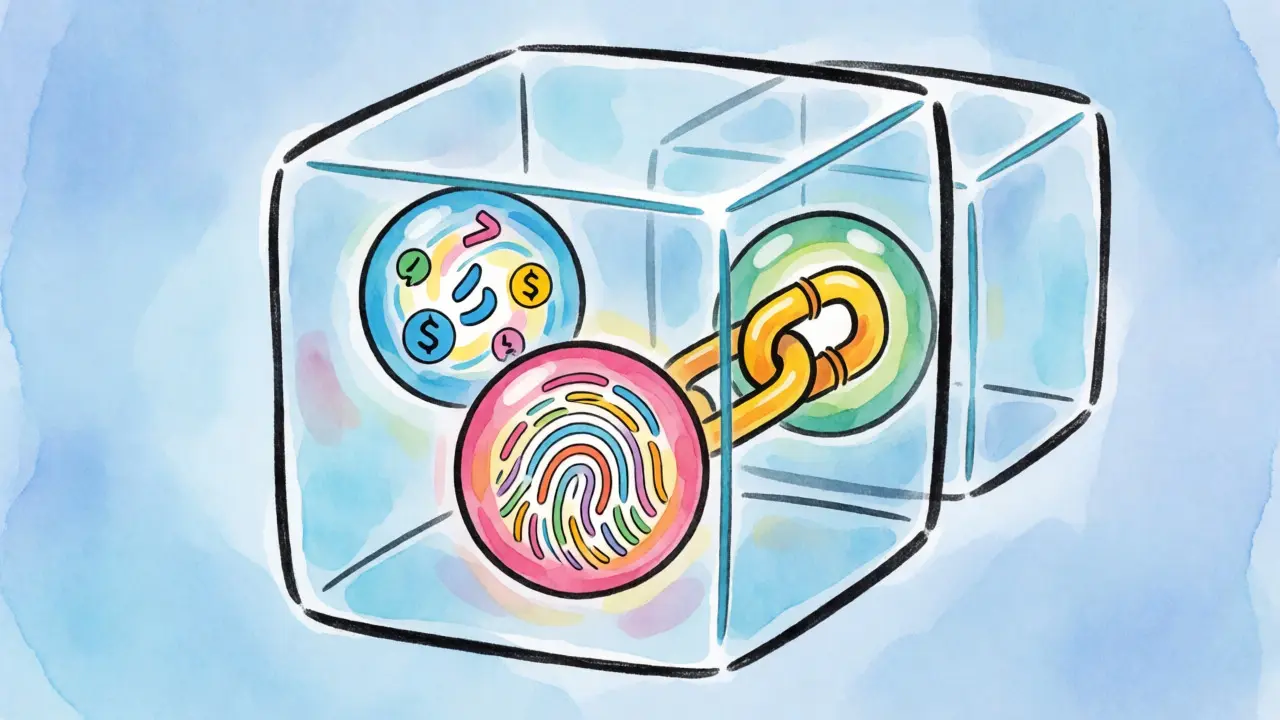
You’ve heard the buzzwords. You know that blockchain is supposed to be secure, transparent, and unchangeable. But have you ever actually looked inside one? Most people treat it like a black box-data goes in, trust comes out. That’s a mistake. To really understand why this technology matters, you need to crack open a single block and see what makes it tick.
Think of a blockchain not as a magical cloud, but as a digital ledger made of physical data structures. Each page in this ledger is a "block." If you can understand how one block is built, you understand the entire system. It’s surprisingly logical once you strip away the jargon. Let’s take a tour through the anatomy of a blockchain block, from its outer shell to its cryptographic core.
The Three Pillars of a Block
Every valid block in a major network like Bitcoin or Ethereum shares a common DNA. Regardless of the specific cryptocurrency, a block is essentially a container holding three critical pieces of information. Without any one of these, the chain breaks.
- Data: The actual transactions or records being stored.
- Hash: A unique digital fingerprint that identifies this specific block.
- Previous Hash: A reference to the block before it, creating the link.
This simple structure is what creates the "chain" in blockchain. It’s recursive. Block B knows about Block A because Block B contains Block A’s hash. If someone tries to rewrite history in Block A, Block B notices immediately because the fingerprint doesn’t match anymore. This interdependence is the secret sauce of immutability.
Diving Deeper into the Block Header
If you look at the raw code of a block, you’ll see it’s split into two main parts: the Block Header and the Block Body. The body is just a list of transactions-boring stuff, mostly. The real magic happens in the header. This small section holds the metadata that secures the entire network.
The header isn't just a label; it's a security checkpoint. It contains specific fields that miners (or validators) must agree on. If even one byte in the header changes, the block’s identity changes completely. Here is what lives inside that header:
| Component | Function | Why It Matters |
|---|---|---|
| Version | Tracks protocol updates | Tells nodes which rules apply to this block. |
| Timestamp | Records creation time | Ensures chronological order and prevents replay attacks. |
| Merkle Root | Hash of all transactions | Allows quick verification of transaction integrity. |
| Previous Hash | Link to prior block | Creates the immutable chain linkage. |
| Nonce | Random number for mining | The variable miners change to solve the puzzle. |
| Difficulty Target | Complexity setting | Controls how hard it is to find a valid hash. |
The Hash: Your Digital Fingerprint
Let’s talk about the Hash. In computer science, a hash is an algorithm that takes an input of any size and turns it into a fixed-length string of characters. For Bitcoin, this uses the SHA-256 algorithm. No matter if your input is one word or a billion words, the output is always 64 hexadecimal characters long.
Here is the crucial part: hashing is deterministic but sensitive. If you change a single comma in a transaction, the resulting hash looks completely different. There is no pattern to predict it. This property is called the avalanche effect.
Imagine you have a document with a seal on it. If you tear the paper, the seal breaks. A hash is like that seal, but mathematical. When a miner finds a valid hash, they are proving that the data inside the block hasn’t been touched since they did the work. If a hacker tries to alter a transaction in an old block, the hash changes. But the next block still points to the *old* hash. Now the chain is broken. The network rejects the tampered block instantly.
The Merkle Tree: Efficient Verification
How does a block store thousands of transactions without becoming a mess? Enter the Merkle Tree. This is a clever data structure named after Ralph Merkle, who patented it in 1979. Instead of listing every transaction linearly in the header, the system pairs them up and hashes them together recursively until only one hash remains. This final hash is the Merkle Root.
Why bother with this complexity? Efficiency. Suppose you want to prove that a specific transaction happened in a block containing 3,000 other transactions. You don’t need to download the whole block. You only need the path of hashes leading from your transaction to the Merkle Root. This allows lightweight clients (like mobile wallets) to verify payments quickly without storing gigabytes of data.
The Nonce and Proof of Work
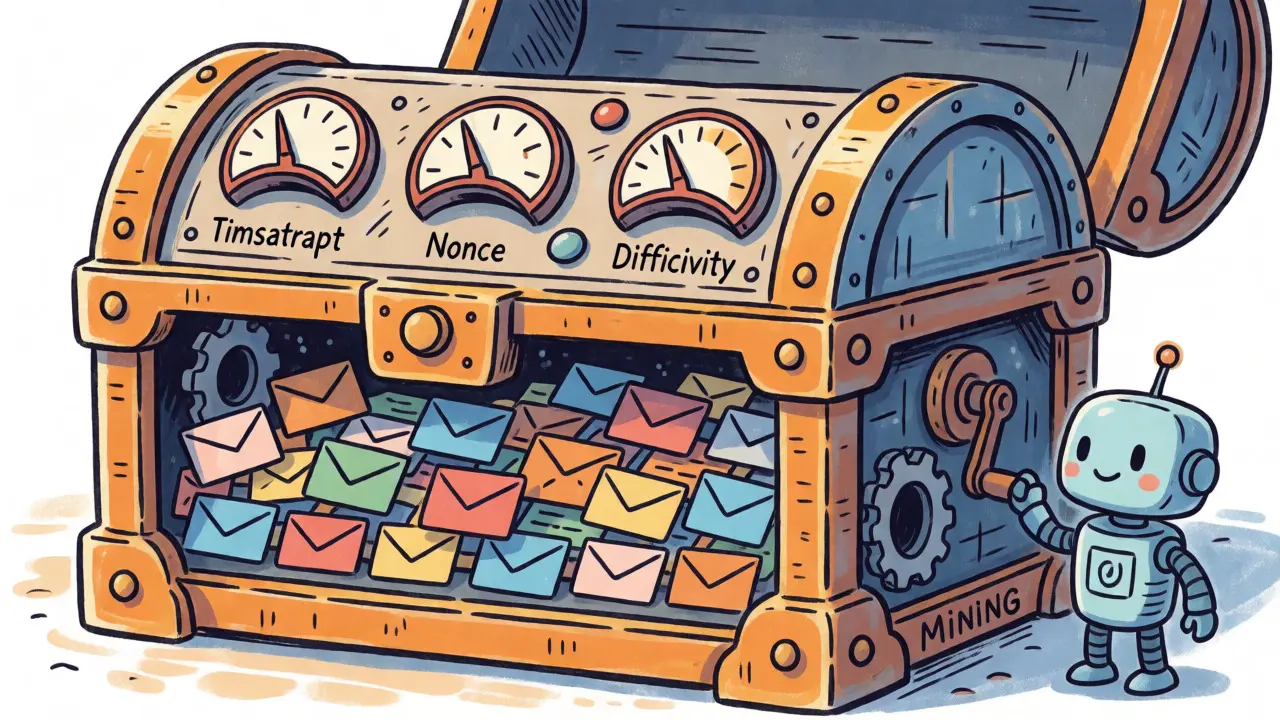
In Proof-of-Work networks like Bitcoin, finding the right hash isn’t automatic. It’s a lottery ticket hunt. Miners compete to find a Nonce (number used once) that, when combined with the block data, produces a hash below a certain target value.
They start with Nonce = 0. They run the hash function. Is the result low enough? Probably not. They try Nonce = 1. Still too high. They might try billions of times. This computational effort secures the network. To change a past block, an attacker would have to redo the proof-of-work for that block and every block after it, faster than the rest of the honest network. On a global network with massive computing power, that’s practically impossible.
How Blocks Link Together
The term "blockchain" describes the linking mechanism perfectly. Each block contains the hash of the previous block. This creates a backward-looking reference. Let’s say we have Block 100, Block 101, and Block 102.
- Block 100 has Hash X.
- Block 101 includes Hash X in its header.
- Block 102 includes the hash of Block 101 in its header.
If you try to edit Block 100, its hash changes from X to Y. Now, Block 101 says "I follow Block X," but Block 100 is now Y. Mismatch. Block 102 also fails validation because its predecessor changed. To fix this, you’d have to recalculate the hash for 101, then 102, and so on, all the way to the current tip of the chain. This domino effect ensures that altering history requires rewriting the present.

Consensus and Finality
A block isn’t added just because a miner found a valid hash. It needs consensus. Other nodes in the network receive the new block and validate it against their own copy of the rules. They check:
- Are the signatures valid?
- Do the inputs exist?
- Is the difficulty correct?
- Does the previous hash match?
If the majority agrees, the block is accepted. In Bitcoin, a transaction is considered highly secure after six confirmations (six blocks added on top). This depth makes reversing the transaction economically prohibitive. The deeper a block sits in the chain, the more immutable it becomes.
Common Misconceptions About Blocks
People often think blocks are huge files containing everything. They aren’t. A Bitcoin block is limited to roughly 1 MB (though SegWit effectively increases this capacity). This limit forces users to pay higher fees during congestion, prioritizing urgent transactions. It’s a trade-off between speed and decentralization.
Another myth is that all blocks are identical. They aren’t. The first block, known as the Genesis Block, has no previous hash-it starts the chain. Also, empty blocks exist. If there are no pending transactions, a miner can still create a block with just the header and a reward transaction for themselves. This keeps the chain moving and the timestamps consistent.
Why This Anatomy Matters for Developers
If you’re building dApps or smart contracts, understanding block structure helps you optimize gas fees and storage. Every piece of data written to the blockchain consumes space in the block body. Since space is finite, writing large strings directly on-chain is expensive. Developers often store hashes on-chain and keep the full data off-chain, using the block’s Merkle Root to verify integrity later. Knowing where the limits are helps you design better systems.
What happens if two blocks are mined at the same time?
This is called a fork. Both blocks point to the same parent. Nodes temporarily accept both. Eventually, the network adds more blocks to one chain, making it longer. Nodes switch to the longest valid chain, orphaning the shorter one. The transactions in the orphaned block are moved back to the mempool to be included in future blocks.
Can I change the timestamp of a block?
Miners set the timestamp, but it must fall within a range acceptable by the network rules (usually within two hours of the current time). If a miner sets a timestamp too far in the future or past, other nodes will reject the block. This prevents manipulation of the timeline.
Is the data in a block encrypted?
No, the data is hashed, not encrypted. Hashing is one-way; you can’t reverse it to get the original data easily, but anyone can read the transactions. Encryption hides data; hashing verifies it. In Bitcoin, addresses are pseudonymous, but transaction amounts and sender/receiver IDs are public.
What is the role of the 'Bits' field?
The Bits field encodes the difficulty target. It tells miners how many leading zeros the hash must have. As more computing power joins the network, the difficulty increases (more zeros required), keeping block discovery time steady at around 10 minutes for Bitcoin.
Do all blockchains use the same block structure?
Most follow the general concept of headers and bodies, but specifics vary. Ethereum blocks include additional fields like state roots and receipt roots. Some newer chains use DAGs (Directed Acyclic Graphs) instead of strict linear chains, changing how blocks link together.

19 Comments
sri harni
September 3, 2026 AT 21:31 PMthis is very good explanation for beginners like me
thank you
Duncan Fisher
September 4, 2026 AT 06:20 AMI really appreciate how you broke down the header components. It’s easy to get lost in the jargon, but seeing the table with the functions made it click for me.
The point about the avalanche effect is particularly powerful. I’ve always struggled to explain why changing one byte matters so much to non-tech friends, and that seal analogy is perfect.
It also helps to remember that the previous hash isn't just a reference; it's the anchor that holds the whole history together.
If we didn't have that recursive link, we'd essentially just have a database with timestamps, which is far less secure.
Thanks for taking the time to write this out clearly.
adam veikkanen
September 4, 2026 AT 14:27 PMMissed the part on SegWit impact on block size limits.
Clarify if Merkle roots are computed before or after nonce adjustment.
Also note Ethereum state root differences.
Good start though.
Rishi Mehta
September 5, 2026 AT 18:45 PMyou people think you understand blockchain because you read one article??
it's all lies designed by central banks to control us
the miners are just pawns and the hashes are fake math
nobody actually checks the blocks they just copy each other
i tried to run a node once and it crashed my pc
so i know what i am talking about
everyone else is sleeping while the elites rewrite the ledger
they can change the genesis block anytime they want
and you sit here praising their little data structures
pathetic
wake up sheeple
the chain is broken already and you don't even know it
Michael Rubin
September 6, 2026 AT 05:49 AMUseful overview of the structural mechanics.
The distinction between hashing and encryption was helpful.
Will keep this bookmarked for future reference.
Kathryn Haber
September 6, 2026 AT 17:40 PMbut what is a block really
is it memory or is it truth
we build chains of moments hoping they hold
but entropy eats everything eventually
the hash is just a scream into the void that echoes back identical
we seek permanence in digital dust
beautiful and terrifying
why do we trust the numbers more than our own memories
perhaps the chain is not external
perhaps we are the nodes validating our own existence
and every transaction is a choice
immutable only until we decide otherwise
mind blown 🤯
Emerson Droguet
September 8, 2026 AT 12:34 PMThis exposition provides a commendable clarity regarding the fundamental architecture of distributed ledgers.
The delineation of the block header fields serves as an excellent pedagogical tool for those new to cryptographic consensus mechanisms.
One might further consider the implications of the timestamp field beyond mere chronological ordering, specifically regarding its role in preventing certain classes of replay attacks across different network states.
The explanation of the Merkle Tree structure effectively highlights the efficiency gains inherent in partial verification methods.
Such architectural choices reflect a profound understanding of the trade-offs between storage overhead and computational validation costs.
It is indeed refreshing to see a breakdown that respects the intelligence of the reader while remaining accessible.
I would encourage further exploration into how these structures adapt under high-load conditions such as network congestion.
The mention of developer optimizations regarding on-chain versus off-chain storage is particularly pertinent for current dApp development practices.
Overall, this piece stands as a robust introduction to the subject matter.
Eugene McGrath
September 9, 2026 AT 02:55 AMstandard boilerplate crypto fluff
didn't even touch on UTXO vs account model nuances
lazy writing
just regurgitating whitepaper basics without any real insight into mempool dynamics or orphan rates
waste of bandwidth
typical US-centric view ignoring Asian market adoption realities
meh
Robert Brabham
September 11, 2026 AT 02:05 AMHonestly, I'm skeptical about the 'immutability' claim here.
We've seen forks happen where the majority rewrote recent history.
If 51% of hashrate decides to revert transactions, that 'chain' breaks instantly.
So calling it unchangeable is a bit misleading, isn't it?
It's only immutable relative to economic incentives.
Which means it's mutable if someone pays enough.
Still, the technical breakdown is solid for what it is.
Sonya Kirkwood
September 11, 2026 AT 08:11 AMI feel like there is something deeper going on with the Nonce.
Why do we need random numbers to prove work?
It feels like a ritualistic element disguised as mathematics.
Are we sure the difficulty targets aren't being manipulated by hidden actors?
The timestamp window seems too loose to prevent collusion among mining pools.
I read somewhere that some blocks have suspiciously low variance in their hash outputs.
That shouldn't happen if the randomness is truly cryptographic.
We need to look closer at the raw hex data of older blocks.
Something doesn't add up in the consensus mechanism description.
Charlotte Richardson
September 12, 2026 AT 12:52 PMThis is a wonderfully structured guide that will undoubtedly help many learners grasp the core concepts.
Your tone strikes a perfect balance between technical accuracy and approachability.
The use of analogies, like the document seal, makes abstract cryptographic concepts tangible.
I particularly appreciated the section addressing common misconceptions, as it preemptively answers questions many newcomers have.
Encouraging developers to optimize for gas fees shows a practical understanding of real-world application.
Keep up the great work in educating the community!
Rachel Aldaco
September 14, 2026 AT 08:05 AMwait but who owns the chain
if everyone has a copy then no one owns it right
that scares me
who controls the updates
you said version tracks protocol updates but who writes the code
is it democratic
feels like oligarchy to me
data goes in trust comes out
but trust in who
in the machine
machines don't care about us
we are just inputs
scary stuff honestly
really scary
Ted Thoroughgood
September 15, 2026 AT 03:30 AMGreat post! Really helped clear up the merkle tree confusion i had.
The part about lightweight clients verifying payments without downloading the whole block is super useful for mobile wallets.
Glad to see this explained simply without dumbing it down too much.
Thanks for sharing this resource! 🚀
Sasha Wilde
September 16, 2026 AT 16:16 PMActually, the previous hash doesn't create immutability alone.
Consensus rules do.
Without social coordination, the longest chain rule fails.
You're conflating technical structure with governance.
Big difference. 💡
Ferdinand Friday
September 17, 2026 AT 22:39 PMTo fully appreciate the elegance of the blockchain block, one must consider it not merely as a container of data, but as a temporal artifact that encapsulates a specific moment in the collective computational effort of the network.
The Merkle Root serves as a cryptographic commitment to the state of transactions at that precise instant, allowing for succinct proofs that can be verified independently of the full historical context.
This design choice reflects a deep philosophical stance on the nature of truth: that truth is not absolute but is instead derived from consensus and verifiable computation.
When we discuss the nonce, we are discussing the physical expenditure of energy required to bind a block to the chain, transforming abstract mathematical puzzles into concrete security guarantees.
The interplay between the difficulty target and the actual hash value creates a dynamic equilibrium that adjusts to the shifting tides of global computing power, ensuring stability amidst chaos.
Furthermore, the pseudonymous nature of the addresses within the block body allows for a form of privacy that exists in tension with the radical transparency of the public ledger.
Developers who ignore these structural nuances often find themselves paying exorbitant fees for inefficient data storage, failing to leverage the off-chain/on-chain hybrid models that define modern scalability solutions.
Thus, understanding the anatomy of a block is akin to understanding the DNA of a new digital civilization, where code is law and cryptography is the constitution.
It is a marvel of engineering that bridges the gap between theoretical computer science and practical economic utility.
We should celebrate this complexity rather than shy away from it, for it is the foundation upon which trustless interaction becomes possible.
Every byte written into that block body represents a decision, a transfer of value, or a smart contract execution that ripples through the network forever.
The immutability promised by the hash linkage is not just a feature; it is a promise kept by millions of independent validators worldwide.
In essence, the block is a monument to human cooperation mediated by mathematics.
Gabriela Gonzalez
September 19, 2026 AT 18:30 PMLove this breakdown! The visualizing of the chain linking is so key 🧠
Especially the part about how changing one block breaks the next ones 🔗
Super helpful for anyone trying to wrap their head around PoW ✅
John Martin
September 20, 2026 AT 15:23 PMA solid foundational read. 👍
I’d suggest adding a bit more on how Ethereum’s block time affects the likelihood of uncle blocks compared to Bitcoin.
But overall, the explanation of the header fields is spot on.
Keep it up! 🛠️
Abid Bhatti
September 21, 2026 AT 15:24 PMThey tell you it's secure but they never say who runs the nodes.
Most nodes are in China and USA anyway.
So the decentralization is a myth.
The hash algorithm could be replaced tomorrow by a quantum computer.
And nobody talks about that risk.
It's all hype.
The block size limit is arbitrary and controlled by a few devs.
Nothing here is truly decentralized.
Just wait until the government mandates KYC on all addresses.
Then your 'private' keys won't mean anything.
I told you so years ago.
Enjoy your imaginary money.
Jess Emmerson
September 22, 2026 AT 20:22 PMNice job breaking this down! I teach intro CS courses and this level of detail is exactly what students need when moving from basic databases to distributed systems.
The comparison of hashing vs encryption is a common pain point for them, so that section is gold.
Also, mentioning the Genesis Block's lack of previous hash is a nice touch for completeness.
Would love to see a follow-up on how these structures handle soft forks vs hard forks technically.
But for now, this is a great resource. Thanks for putting it together! 😎