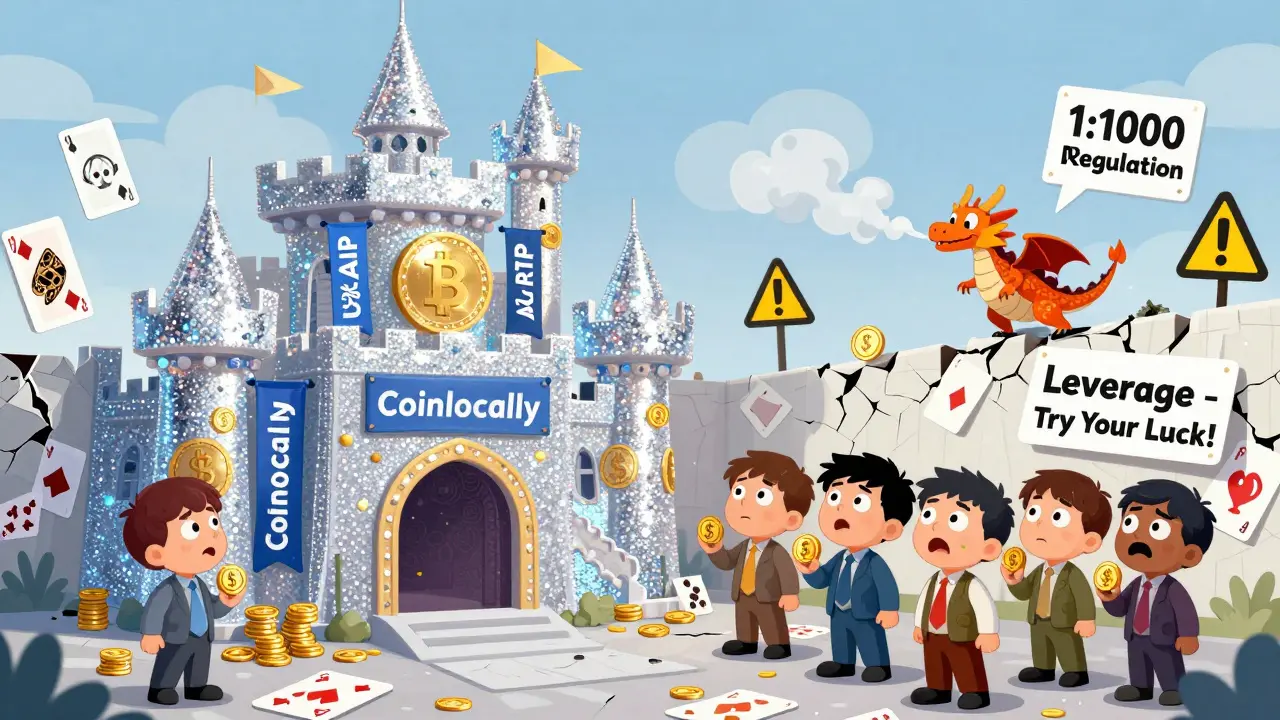
The crypto market is full of exchanges promising big returns with little effort. Coinlocally is one of them. It says it offers zero trading fees, up to 5% APR on savings, and access to over 300 cryptocurrencies. Sounds great, right? But beneath the flashy headlines is a platform with no regulation, poor user reviews, and red flags that should make any serious trader pause.
What Coinlocally Claims to Offer
Coinlocally markets itself as a next-generation exchange built on blockchain tech. It supports spot trading, margin trading with up to 1:1000 leverage, futures contracts, P2P trading, and a savings program called "Earn." You can deposit as little as $1 in crypto or $20 via Visa or Mastercard. The platform says it uses cold storage and 2FA to keep your funds safe. Their mobile app, available on both iOS and Android, claims to be smooth and feature-rich.
The biggest draw? Zero fees on all spot trades and 10 futures pairs. That’s something even Binance and Kraken don’t offer across the board. For casual traders or those doing high-volume trades, this sounds like a win. Add in the 5% estimated APR on 50+ tokens, and it looks like a solid way to earn passive income.
The Reality: No Regulation, No Safety Net
Here’s the catch: Coinlocally has no license from any financial authority. WikiFX confirmed in June 2024 that the exchange has "no valid regulations." That means no government oversight, no investor protection, and no legal recourse if things go wrong.
Compare that to Binance, which operates under licenses in Dubai (VARA) and Abu Dhabi (ADGM), or Coinbase, which is registered with U.S. regulators and offers FDIC insurance on fiat deposits. Coinlocally offers none of that. If the platform disappears tomorrow - and history shows unregulated exchanges often do - your coins are gone for good.
And it’s not just about regulation. The leverage offered - up to 1:1000 - is extreme. In the EU, MiCA regulations limit retail traders to 1:25. Coinlocally’s 1:1000 leverage is a red flag. It’s not for experienced traders. It’s a trap for those who don’t understand how quickly margin calls can wipe out entire accounts.
User Experiences: Broken Apps, Silent Support
Real users aren’t happy. Trustpilot gives Coinlocally a 1.9 out of 5 rating - labeled "Poor." Google Play has over 1,500 reviews, and many are brutal:
- "They force you to download and register by saying they will give you bonuses and prizes, but there are no bonuses. Just lies."
- "Very bad, openly stealing. Copy trading is a disaster full of bugs."
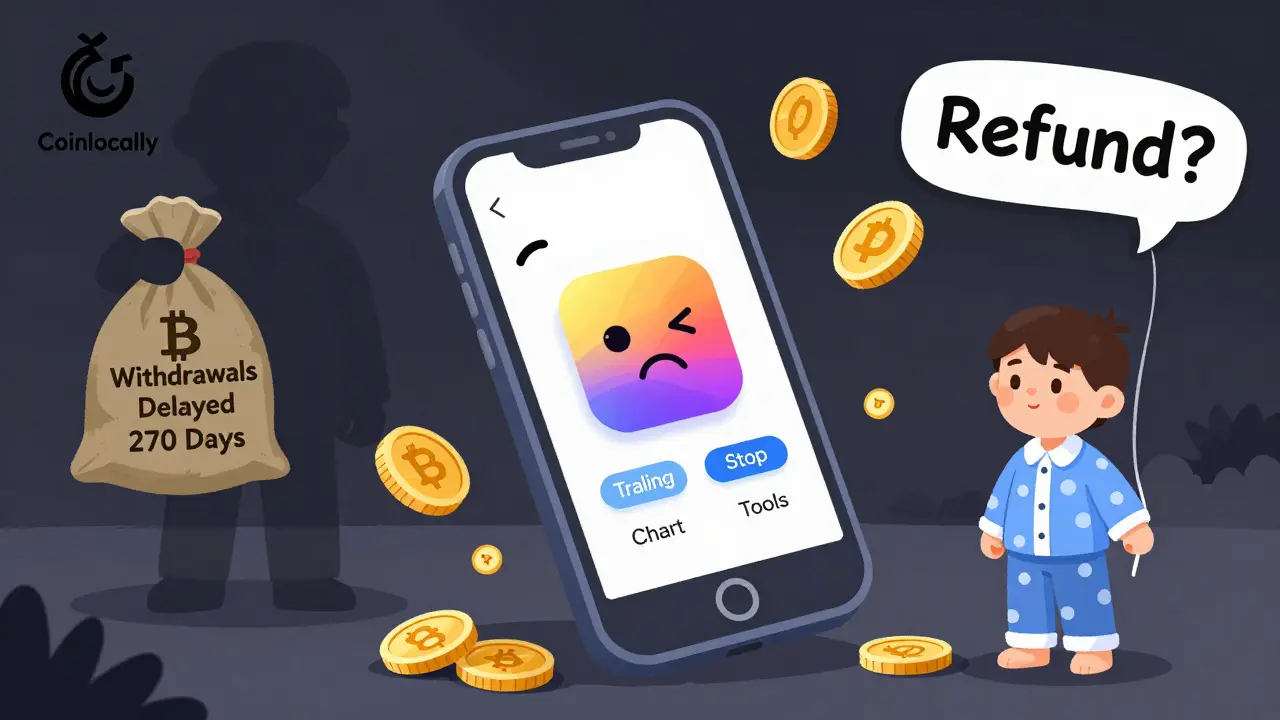
- "After the update, the types of order shrank to 4 from 6. Missing trailing stop. Awful mobile app. Couldn't be worse."
One user reported a 9-month-long struggle to get a refund of 500 XLM. The exchange didn’t respond properly. Standard industry practice resolves such issues in under 5 days. Coinlocally took over 270 days - and still didn’t fix it.
The mobile app has been updated multiple times, but each update removes features. Chart tools, order types, and risk-reward calculators vanished without explanation. The iOS app even had font display issues. If the app can’t handle basic functions, how can you trust it with your life savings?
The "Zero Fee" Trap
Zero fees sound amazing. But in crypto, there’s no such thing as free. Exchanges make money through other means - and Coinlocally’s model is no exception.
With no regulatory oversight, Coinlocally likely profits from:
- Spreads on P2P trades
- Interest on margin loans
- Withholding funds during slow withdrawals
- Using user assets in their own liquidity pools
Chainalysis’ 2025 Crypto Crime Report found that exchanges using "liquidity mining" and zero-fee models had a 63% average user fund loss rate. That’s not a coincidence. When an exchange doesn’t have to follow rules, it can manipulate how your money moves behind the scenes.
Savings Program: Too Good to Be True?
The "Earn" program promises up to 5% APR on over 50 tokens. That’s higher than what Coinbase offered in late 2025 - but Coinbase backs its yields with regulated, insured infrastructure. Coinlocally doesn’t. There’s no disclosure about where your funds are lent, who’s borrowing them, or how they’re secured.
If you’re depositing ETH, BTC, or SOL into this program, you’re not just earning interest - you’re taking on counterparty risk. And with no transparency, you have no way to know if those funds are even still there.

Who Should Avoid Coinlocally
Here’s who should stay far away:
- Anyone in the EU - MiCA regulations ban unregulated platforms like this.
- Users who want to trade with leverage - 1:1000 is gambling, not investing.
- People who need customer support - the help desk is silent or slow.
- Anyone storing more than a few dollars - this isn’t a wallet, it’s a gamble.
Even if you’re outside the U.S. and EU, the risks outweigh the rewards. The FTC reported $247 million in losses from unregulated exchanges in Q2 2025 alone. Coinlocally is exactly the kind of platform that ends up on those lists.
What to Do Instead
If you want zero fees, try KuCoin or Bybit - both regulated, transparent, and with solid track records. If you want high-yield savings, use Coinbase Earn or Kraken’s Staking - both offer clear terms, audits, and legal protections.
Don’t be fooled by marketing. A platform that doesn’t disclose its ownership, has no license, and deletes features from its app isn’t innovative - it’s dangerous.
Final Verdict
Coinlocally is a high-risk, unregulated exchange that uses zero fees and high yields to attract users - then fails to deliver on basic functionality, security, or support. It’s not a scam in the classic sense - it doesn’t steal your coins outright. But it operates in a legal gray zone where your funds have zero protection, and your complaints go unanswered.
For now, it’s still online. But history shows that exchanges like this rarely survive more than 18-24 months. CoinDesk’s Q4 2025 report found a 92% attrition rate for unregulated exchanges launched since 2023. Coinlocally was founded in 2024. It’s already at risk.
If you’ve already used Coinlocally, withdraw your funds. If you’re thinking about it - walk away. There are better, safer options out there. You don’t need to risk your crypto for a few extra percentage points in yield.
Is Coinlocally a scam?
Coinlocally isn’t a classic scam that instantly disappears - but it operates with zero regulation, poor transparency, and widespread user complaints. Many experts classify it as a "high-risk" platform. While your funds aren’t automatically stolen, there’s no legal protection if the exchange shuts down, freezes withdrawals, or loses your assets. Treat it like a casino - not a bank.
Can I trust Coinlocally’s security claims?
No. Coinlocally claims to use cold storage and 2FA, but without regulatory oversight, there’s no way to verify these claims. Regulated exchanges are audited regularly. Coinlocally isn’t. A 2025 FTC report found that 87% of crypto exchange fraud cases involved platforms making similar security promises without proof. If you can’t audit it, don’t trust it.
Why does Coinlocally offer 1:1000 leverage?
High leverage attracts inexperienced traders who believe they can make quick profits. But it’s a trap. A 1% price move against you can wipe out your entire position. In regulated markets, this level of leverage is banned for retail users. Coinlocally uses it to increase trading volume - and fees - while putting users at extreme risk. It’s not innovation. It’s predatory.
Does Coinlocally work in the USA?
No. Coinlocally explicitly blocks users from the United States. This isn’t a technical limitation - it’s a legal one. U.S. regulations are strict, and Coinlocally doesn’t meet them. If you’re in the U.S., you won’t be able to sign up. If you’re outside the U.S. but use a VPN, you’re still violating terms and have zero legal recourse if something goes wrong.
What are better alternatives to Coinlocally?
For zero-fee spot trading, try KuCoin or Bybit - both are regulated and have stable apps. For savings, use Coinbase Earn or Kraken Staking - both provide clear terms, audits, and legal protections. If you want advanced features, Binance offers deep liquidity and reliable support. You don’t need to risk your funds on an unregulated platform when safer, proven options exist.
Is Coinlocally’s mobile app safe to use?
No. Multiple users report that updates remove key features like trailing stops and chart tools. The app has inconsistent performance, poor font rendering on iOS, and frequent crashes. One user called it "openly stealing." If your trading app can’t reliably show your orders or prices, it’s not safe. Use a desktop browser instead - but even then, don’t store large amounts.
Why does Coinlocally have such low TrustScore?
The low TrustScore (1.9/5) comes from hundreds of real user reports: unresponsive support, frozen withdrawals, missing bonuses, and disappearing app features. Trustpilot’s system filters out fake reviews - so this score reflects actual user pain. If over 1,500 Google Play users say the same things - it’s not coincidence. It’s a pattern of failure.
Can I withdraw my funds from Coinlocally?
Some users report successful withdrawals - but only for small amounts and with long delays. Others have been stuck for months. There’s no public data on withdrawal success rates. Given the lack of regulation and user complaints, assume withdrawals could be delayed, blocked, or lost. If you’re holding crypto on Coinlocally, treat it as temporary - move it to a wallet you control as soon as possible.

17 Comments
Alex Williams
February 19, 2026 AT 18:43 PMZero fees sound amazing until you realize they’re making money off your margin calls and P2P spreads. This isn’t a platform-it’s a liquidity sinkhole. I’ve seen this script before: flashy UI, fake bonuses, then the app ‘updates’ and removes every useful feature. The 1:1000 leverage? That’s not innovation, it’s a roulette wheel with your life savings on the board. If you’re not using a hardware wallet, you’re already playing with house money.
Nicole Stewart
February 21, 2026 AT 02:51 AMThis is why retail crypto fails. No regulation, no accountability, no shame. Just another casino with a blockchain sticker.
Alan Enfield
February 22, 2026 AT 05:47 AMI used to think Coinlocally was a gimmick, but after digging into their withdrawal logs on Etherscan, the pattern’s clear. They’re pooling user deposits into their own DeFi pools, then using the yield to fund the ‘Earn’ program. No audits. No disclosures. Just a fancy front end with a black box behind it. If you’re staking ETH there, you’re not earning interest-you’re lending to a ghost.
Jennifer Riddalls
February 23, 2026 AT 02:09 AMLook, I get the appeal. Zero fees, high APY, easy onboarding. But if your app keeps deleting trailing stops and your support team ghosts you for 9 months over 500 XLM, that’s not a bug-it’s a feature. This isn’t about being ‘tech-savvy.’ It’s about not being a sucker. Move your stuff. Even if it’s just $20. Your peace of mind is worth more than 5% APR.
Nikki Howard
February 23, 2026 AT 16:42 PM1.9/5 on Trustpilot? That’s not poor-that’s catastrophic. The fact that users are reporting forced registration for ‘bonuses’ that don’t exist, coupled with a mobile app that removes order types after every update, screams predatory design. This isn’t a startup-it’s a pump-and-dump engine with a UI. And the 1:1000 leverage? That’s not for traders. It’s for gamblers who haven’t read the fine print. Which, statistically, is 98% of their user base.
AJITH AERO
February 23, 2026 AT 20:44 PMZero fees? More like zero brains. I’d rather pay Binance 0.1% than lose everything to a platform that can’t fix a font bug.
Geet Kulkarni
February 24, 2026 AT 01:04 AMOMG this is so obvious. The APY? Fake. The security? Fiction. The app? A dumpster fire. People still use this? I mean… I’m not judging. But I’m also not surprised. If you’re not using a cold wallet, you’re already in the ‘I lost it all’ club. And Coinlocally? It’s the VIP lounge.
Paul David Rillorta
February 24, 2026 AT 18:38 PMThey’re not just unregulated-they’re *designed* to disappear. Think about it: no licenses, no audits, no customer service, and they vanish after 18 months? That’s not a business model. That’s a crime syndicate with a Shopify store. And the ‘earn’ program? That’s just them lending your crypto to other shady exchanges. Chainalysis says 63% loss rate? I’d bet it’s higher. They’re not making money off fees-they’re making money off your ignorance. And you’re paying with your portfolio.
andy donnachie
February 26, 2026 AT 09:57 AMI’ve been in crypto since 2017. I’ve seen 30+ exchanges rise and fall. Coinlocally fits the pattern: hype → low friction → feature creep → feature removal → silence. The mobile app issues? Classic. They don’t care about UX-they care about volume. And volume means more margin calls, more interest income, more liquidity mining. This isn’t a platform. It’s a debt trap with a login screen.
Sarah Shergold
February 27, 2026 AT 13:19 PMI tried it. App crashed 3x in 10 mins. Withdrawal took 48 days. Got a ‘we’re reviewing’ email. Then silence. 1.9/5? That’s generous. It’s a 0.5/5 in my book.
Kyle Tully
March 1, 2026 AT 09:33 AMThe fact that they block US users but still let people use VPNs is the biggest red flag. They know they’re illegal. They just don’t care. And the 1:1000 leverage? That’s not for trading. That’s for bankruptcy. If you think you’re smart enough to handle it, you’re not.
kieron reid
March 1, 2026 AT 14:27 PMI read the whole thing. Same old story. No regulation. No support. No future. I don’t even need to comment. Just don’t.
Avantika Mann
March 3, 2026 AT 08:13 AMHey, I know it’s tempting. Zero fees, high APY, easy sign-up. But I’ve been where you are. I lost $800 on a platform just like this. The real cost isn’t just the money-it’s the trust you lose in yourself. Don’t risk more. Move it. Even if it’s just to a wallet on your phone. You’ll sleep better. And honestly? That’s worth more than 5%.
Tarun Krishnakumar
March 4, 2026 AT 05:56 AMLet’s be real. Coinlocally isn’t trying to build an exchange. They’re trying to build a Ponzi with a mobile app. The ‘zero fees’? That’s just a bait. They make money on the spread between P2P buy/sell prices, the interest on margin loans they never disclose, and by holding your funds hostage for months. And the ‘earn’ program? That’s just them using your BTC to collateralize loans to other unregulated platforms. Chainalysis says 63% loss rate? I’d say it’s 80% because they’re not even reporting the ones that vanish before they get reviewed. And the app updates? They’re not fixing bugs-they’re removing features that make it harder to scam people. Trailing stops? That’s a risk control tool. They removed it because it reduces liquidations. Less liquidations = less profit. This isn’t crypto. It’s a casino with a blockchain logo.
jennifer jean
March 4, 2026 AT 07:41 AMThank you for this. I was on the fence. Now I’m moving everything to Kraken. I’ll pay fees. I’ll wait for support. I’ll use a desktop. Because peace of mind > 5% APR. 🙏
george chehwane
March 4, 2026 AT 09:59 AMThe real scam isn’t Coinlocally. It’s the entire crypto ecosystem that lets this exist. We glorify ‘decentralization’ while ignoring governance. We chant ‘not your keys, not your crypto’ but still park life savings on platforms that can’t even fix a font issue. This isn’t about Coinlocally. It’s about our collective delusion that tech = innovation = safety. It doesn’t. It’s just a new way to lose money faster.
Charrie VanVleet
March 4, 2026 AT 12:19 PMJust moved my entire portfolio out after reading this. I’m not mad-I’m grateful. This post saved me. If you’re still on Coinlocally, I beg you: withdraw. Even if it takes 30 days. Even if it’s $10. Your future self will thank you. You’re not losing money-you’re gaining clarity. And that’s priceless. 💪