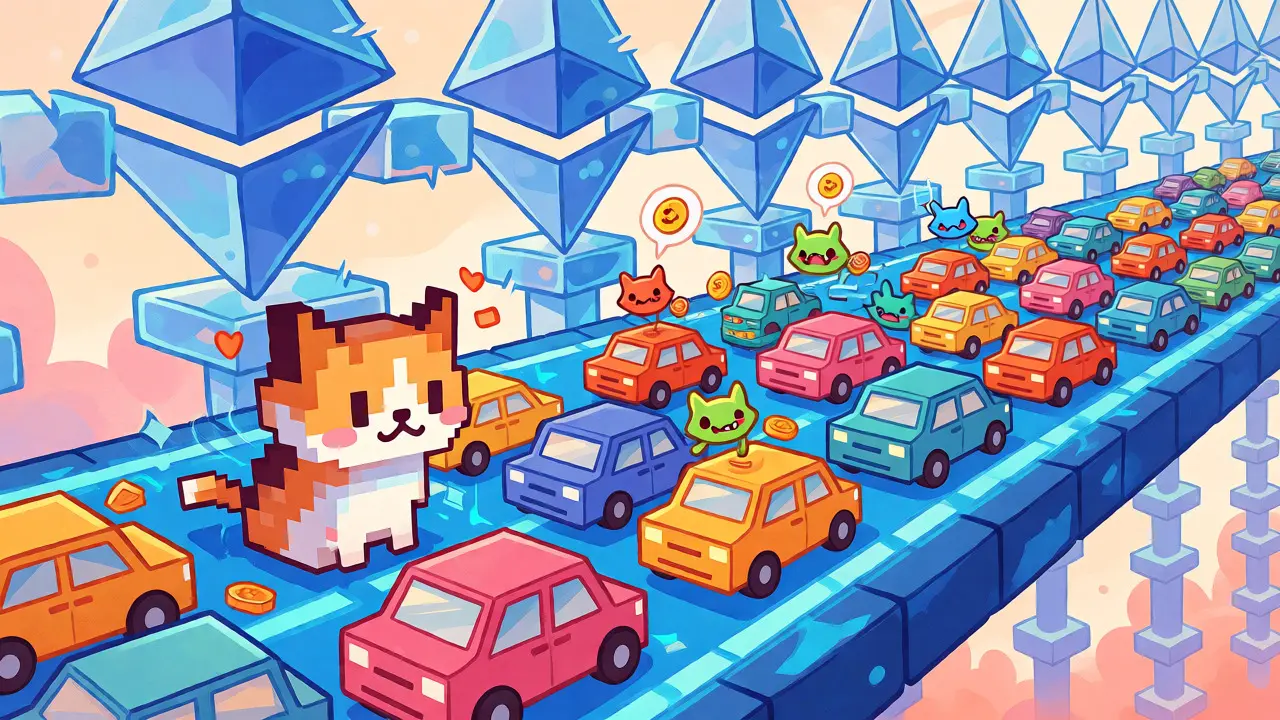
Remember when CryptoKitties froze the entire Ethereum network in late 2017? That wasn't just a meme moment; it was the stress test that forced the industry to realize we needed better rules for digital ownership. Before that chaos, "non-fungible" was mostly academic jargon. Today, with over 35 million collections floating across various chains, the technical backbone holding them together has undergone a radical transformation. We aren't just talking about JPEGs anymore. The evolution of NFT token standards is the story of how we went from fragile experiments to robust financial instruments capable of supporting gaming economies, real estate deeds, and complex identity systems.
The Pre-History: Colored Coins and Quantum
Most people think NFTs started with CryptoPunks or Bored Apes. But the DNA of non-fungibility goes back further. In 2012, Meni Rosenfield introduced the concept of "Colored Coins." He wanted to use Bitcoin's blockchain to track metadata for real-world assets like gold certificates or real estate. It was clunky and hard to scale, but it planted the seed: you can attach unique data to a transaction.
Then came May 3, 2014. Digital artist Kevin McCoy created "Quantum," widely considered the first true NFT. It lived on the Namecoin blockchain, not Ethereum. It was a simple pixelated octagon that changed color and pulsed. Why didn't it take off then? Because there were no wallets to hold it, no marketplaces to sell it, and crucially, no standard way to transfer it between users. You had to manually manage keys and transactions. The technology existed, but the infrastructure did not.
ERC-721: The Foundation Stone
Everything changed in January 2018 when the Ethereum community finalized EIP-721, now known as ERC-721. This standard provided the missing piece: a universal language for non-fungible tokens. Unlike fungible tokens (like ETH or USDC), where one unit is identical to another, ERC-721 defined a contract structure where every token has a unique uint256 ID.
The genius of ERC-721 wasn't just uniqueness; it was interoperability. By defining mandatory functions like balanceOf, ownerOf, and transferFrom, any wallet or marketplace could read any ERC-721 contract without custom coding. If you built an app that supported one NFT collection, you automatically supported millions of others. This is why OpenSea exploded. They didn't have to integrate each project individually; they just spoke the ERC-721 language.
| Function | Purpose | Impact on User Experience |
|---|---|---|
ownerOf(tokenId) |
Returns the address owning a specific token ID. | Allows wallets to display "You own this" accurately. |
transferFrom(from, to, tokenId) |
Moves a specific token from one user to another. | Enables secure peer-to-peer trading without escrow. |
approve(spender, tokenId) |
Grants permission to spend a specific token. | Required for listing on marketplaces like OpenSea. |
tokenURI(tokenId) |
Points to metadata (image, attributes). | Displays the visual asset in browsers and apps. |
However, ERC-721 had a glaring flaw: inefficiency. Every single transfer required its own transaction. If you wanted to buy ten items, you paid gas fees ten times. For high-value art, this was fine. For gaming, where players might trade hundreds of low-value swords or potions daily, it was economically impossible. Gas costs averaged $1.42 per transfer during peak congestion periods, which killed volume for smaller assets.
ERC-1155: The Multi-Token Revolution
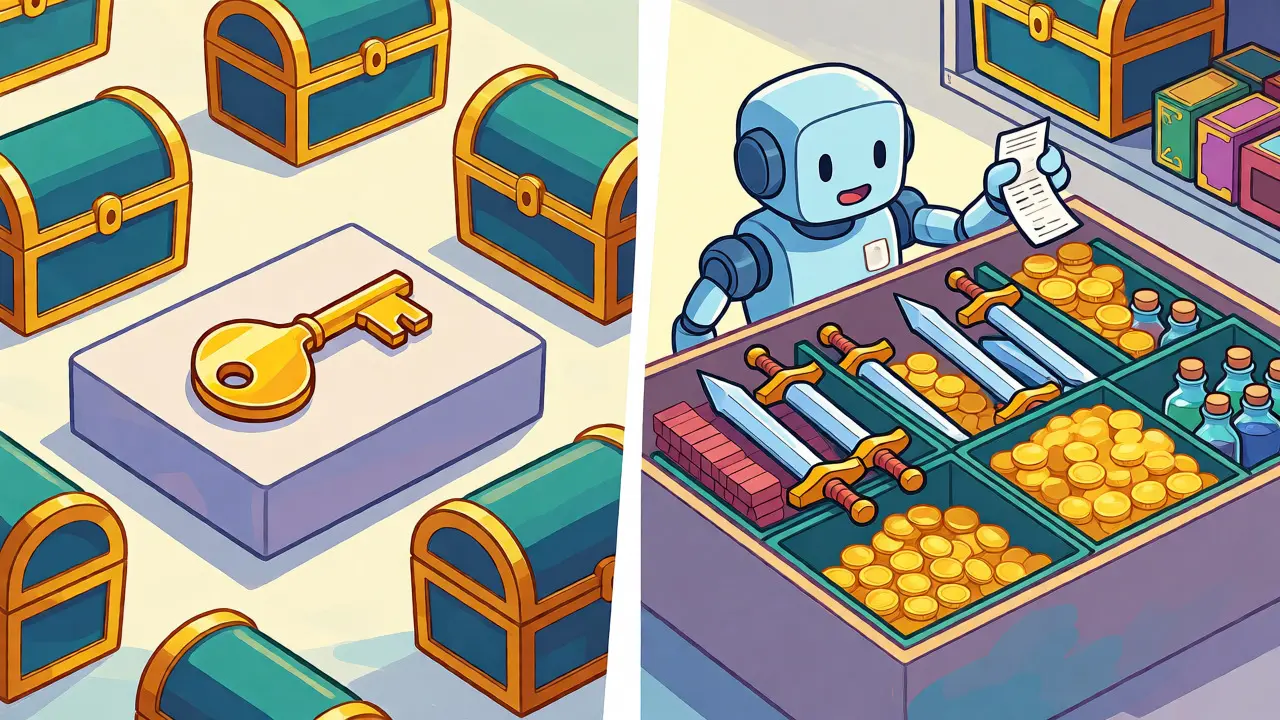
Enter Witek Radomski from Enjin. In June 2018, he proposed ERC-1155, a standard designed to solve the batch problem. Think of ERC-721 as having a separate bank account for every single item you own. ERC-1155 is like a single warehouse where you store different types of goods-some unique (like a signed baseball), some fungible (like packs of cards)-all under one roof.
The architectural shift here is massive. ERC-1155 allows a single smart contract to manage multiple token types. A game developer can deploy one contract containing all their items. When a player trades five common swords and one legendary shield, it happens in one transaction. Data shows this reduces gas costs by up to 90% compared to executing five separate ERC-721 transfers. Axie Infinity, a pioneer in play-to-earn games, migrated 2.1 million assets to ERC-1155 in late 2021, cutting their operational costs by 83%. This efficiency unlocked new business models where micro-transactions became viable.
But there's a catch. Compatibility. Not every wallet supports ERC-1155 out of the box. MetaMask, the most popular browser extension, only added full support in version 8.0 (January 2020). Older wallets often failed to display these tokens correctly, leading to confusion. Users would see their balance but couldn't easily view the images or attributes. This fragmentation remains a hurdle for mainstream adoption today.
Beyond Ethereum: Solana and Cross-Chain Realities
Ethereum isn't the only player. As gas fees spiked in 2021-2022, developers looked elsewhere. Solana emerged as a major alternative, using a different consensus mechanism (Proof-of-History) to achieve near-instant finality. Their NFT standard, implemented via the Metaplex protocol, operates differently. There is no "standard" in the same sense as EIPs; instead, Metaplex provides a framework for creating and managing NFTs on Solana.
The value proposition here is speed and cost. Transferring an NFT on Solana costs fractions of a cent ($0.00025 average), making it ideal for social media integrations where users mint thousands of small collectibles. However, this comes with trade-offs. Ethereum offers higher security guarantees due to its longer history and larger validator set. Solana has experienced network outages, raising questions about reliability for high-stakes assets. If you're selling a $1 million artwork, you likely want Ethereum. If you're distributing free commemorative tickets to 100,000 fans, Solana makes more sense.
The Next Frontier: Token Bound Accounts (ERC-6551)
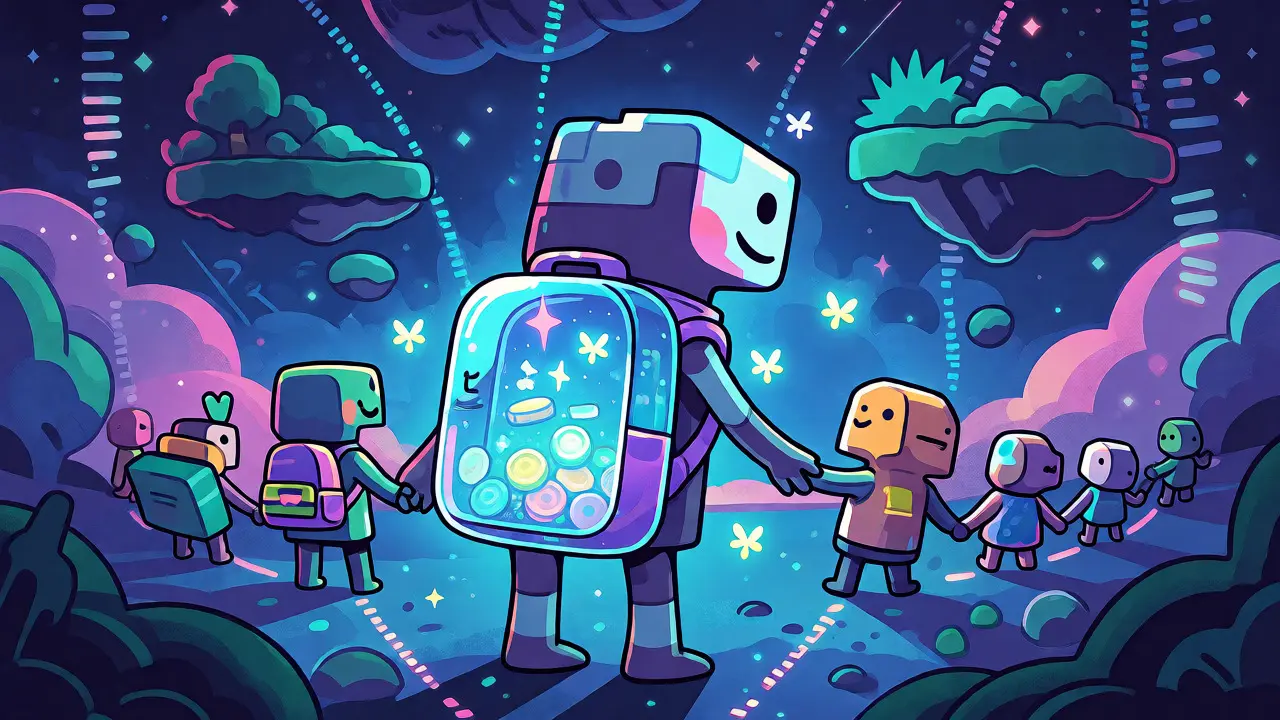
We are currently witnessing the next big leap: ERC-6551, or Token Bound Accounts (TBAs). Proposed in early 2023, this standard changes the fundamental nature of what an NFT is. Until now, an NFT was just a passive object owned by a wallet. With ERC-6551, the NFT itself becomes a wallet.
Imagine your Bored Ape Yacht Club (BAYC) NFT isn't just a picture; it has its own Ethereum address. It can hold other tokens, execute transactions, and even sign messages. This unlocks incredible composability. Your avatar could hold its own clothing inventory (other NFTs) and pay for upgrades using its own treasury. It transforms static collectibles into active agents within the economy. Early adopters are already experimenting with this for gaming guilds and decentralized autonomous organizations (DAOs), where membership tokens act as voting wallets.
Practical Implications for Creators and Developers
If you're building or buying today, which standard should you choose? Here’s a quick heuristic:
- Choose ERC-721 if: You are launching high-value digital art, music albums, or limited-edition collectibles. The ecosystem support is unmatched, and collectors expect this format for prestige assets.
- Choose ERC-1155 if: You are building a game, utility platform, or loyalty program. If users will trade multiple items frequently, the gas savings are critical. Also, consider this if you need to mix fungible (points/currency) and non-fungible (items) assets in one system.
- Consider Solana/Metaplex if: You prioritize low-cost distribution and high throughput. Ideal for mass-market campaigns, event ticketing, or social media features where friction must be zero.
Developers face practical challenges too. Metadata management is the biggest pain point. Most NFTs don't store images on-chain because it's too expensive. Instead, they link to IPFS or centralized servers. If that server goes down, your NFT becomes a blank square. Nansen reports that nearly 13% of collections suffer from broken metadata links. Always use permanent storage solutions like Filecoin-backed pinning services, not temporary cloud hosts.
Security is another layer. A 2022 study found that 68% of ERC-721 contracts had vulnerabilities related to approval mechanisms. Using audited libraries like OpenZeppelin is non-negotiable. Don't write custom logic unless you absolutely have to. The community has solved most edge cases; reinventing the wheel usually leads to bugs.
The Future of Ownership
The trajectory is clear: we are moving toward hybrid standards. Gartner predicts that by 2025, 70% of enterprise implementations will combine elements of ERC-721, ERC-1155, and custom extensions. We are also seeing regulatory pressure. The Bank for International Settlements warns that current standards lack clarity for financial integration. Expect updates focused on compliance, such as embedded KYC checks or royalty enforcement mechanisms directly in the token contract.
Ultimately, the evolution of NFT standards mirrors the maturation of the web itself. We went from static HTML pages (Colored Coins) to interactive JavaScript sites (ERC-721) to dynamic, stateful applications (ERC-1155 and TBAs). The code is becoming invisible to the user, but its impact is growing. Whether you're a collector, gamer, or developer, understanding these layers helps you navigate the noise. The next time you click "buy," remember: you're not just purchasing a file. You're interacting with a sophisticated protocol stack that took a decade to build.
What is the main difference between ERC-721 and ERC-1155?
ERC-721 is designed for strictly unique tokens, where each item has its own contract instance or unique ID within a contract. It is best for high-value, one-of-a-kind assets like art. ERC-1155 is a multi-token standard that allows both fungible and non-fungible tokens to exist in a single contract. It supports batch transfers, significantly reducing gas costs, making it ideal for gaming and utility items where many transactions occur.
Why did CryptoKitties cause network congestion?
CryptoKitties launched before ERC-721 was fully standardized and optimized. Each cat breeding or transaction required significant computational power. Because Ethereum processes transactions sequentially, the sudden influx of thousands of users trying to breed cats overwhelmed the block space, causing delays and skyrocketing gas fees for everyone else on the network.
Are NFTs stored on the blockchain?
Usually, no. Storing large image files directly on the blockchain is extremely expensive. Instead, the NFT stores a hash or URI pointing to the metadata location, typically on IPFS (InterPlanetary File System) or a centralized server. The blockchain verifies ownership and authenticity, while the actual image resides off-chain.
What are Token Bound Accounts (ERC-6551)?
ERC-6551 allows an NFT to have its own Ethereum address. This means the NFT can hold other tokens, execute transactions, and interact with smart contracts independently of its owner. It turns passive collectibles into active participants in the Web3 economy, enabling use cases like avatars with their own inventories and treasuries.
Which blockchain has the cheapest NFT transactions?
Solana generally offers the lowest transaction costs, averaging around $0.00025 per transfer. Other Layer 2 solutions on Ethereum, like Polygon or Arbitrum, also offer very low fees compared to Ethereum Mainnet. However, lower fees sometimes come with trade-offs in security decentralization or network stability.

20 Comments
Caro Kinsella Ireland
November 2, 2026 AT 20:16 PMIt is truly fascinating to observe how the industry has matured from those chaotic early days of CryptoKitties. The transition from fragile experiments to robust financial instruments represents a significant leap in technical sophistication that benefits everyone involved.
Sarah Boudreau
November 3, 2026 AT 19:49 PMThis is such a great breakdown! I love seeing how far we've come since 2017, it really gives me hope for the future of digital ownership and creative economies!
Anna Smith
November 4, 2026 AT 14:02 PMWhile the historical context is adequately provided, one cannot ignore the sheer pretentiousness of calling JPEGs "financial instruments." Most collectors are merely speculating on social status rather than engaging with any underlying utility or fundamental value proposition that justifies the technical complexity described herein.
Gaurav Sharma
November 5, 2026 AT 21:42 PMThe article is verbose. Too many words. Could have been shorter.
VAGHELA SUMIT
November 6, 2026 AT 10:46 AMI found this incredibly insightful because it connects the dots between the initial stress tests caused by CryptoKitties and the current sophisticated standards like ERC-6551 which allow NFTs to act as wallets themselves creating a whole new layer of composability that was previously unimaginable in the early days of blockchain technology when everything felt so experimental and risky compared to today's more structured environment where developers can actually build sustainable business models without worrying about every single transaction costing more than the item itself which is a huge win for gaming economies specifically.
Kadon Douglas
November 6, 2026 AT 11:35 AMYou missed a crucial point about cross-chain interoperability. While you mention Solana, you fail to address the bridging issues that plague these ecosystems. If an asset loses its identity when moving chains, the standard means nothing. Furthermore, the security guarantees of Ethereum are often overstated when considering validator centralization risks.
Amanda Savluchinske
November 8, 2026 AT 01:27 AMGreat work highlighting the practical implications for creators! It is essential to choose the right standard based on your specific use case rather than following trends blindly. Your heuristic section is particularly useful for developers trying to navigate these complex choices efficiently and effectively.
Elisa Gray
November 9, 2026 AT 05:57 AMI appreciate the philosophical angle here. We are indeed moving toward invisible code, much like the web evolved. However, we must respect the boundaries of user understanding; if the tech becomes too abstract, adoption stalls. Balance is key.
Leslie Barrs
November 10, 2026 AT 17:42 PMThis helps a lot. I didn't know about the broken metadata links before. That sounds scary for people who spent money on art.
John Corr
November 11, 2026 AT 12:38 PMOh, fantastic. Another article explaining why my expensive JPEGs are actually just database entries pointing to a server that might crash next Tuesday. Truly riveting stuff.
melissa armstrong
November 12, 2026 AT 19:51 PMThank you for this comprehensive overview! It serves as an excellent resource for both newcomers and seasoned developers looking to refresh their knowledge on token standards. The distinction between ERC-721 and ERC-1155 is clearly articulated and very helpful.
Marvellous Eje
November 12, 2026 AT 22:47 PMIt is morally bankrupt... to treat digital art... as mere speculation!!! ...We should care about the soul... of the creator... not the gas fees... of the trader!!! ...This industry... is lost...
Taylor Brockett
November 14, 2026 AT 06:23 AMThe analysis regarding metadata storage is particularly pertinent. As noted, reliance on centralized servers introduces a single point of failure that contradicts the decentralized ethos of blockchain. Developers must prioritize permanent storage solutions to ensure long-term viability.
tamil thai
November 14, 2026 AT 08:23 AMEveryone is hyping ERC-6551 but nobody talks about how it will break existing dApps that assume NFTs are passive. This isn't progress, it's fragmentation disguised as innovation. We are just creating more headaches for users who don't understand wallet addresses attached to pictures.
Cameron Scott
November 15, 2026 AT 19:52 PMWOW THIS IS HUGE!! I'm literally shaking reading about Token Bound Accounts!! Imagine your avatar buying its own clothes automatically?? That is insane potential!! Let's gooo!!
Munesh kumar
November 16, 2026 AT 19:43 PMActually, technically speaking... most of what you wrote is basic knowledge... available since 2021... But sure, let's pretend... this is breaking news... for the masses... who need hand-holding... through the basics... of smart contracts... Bravo... 👏
Sarah Noelle
November 17, 2026 AT 19:54 PMI think it's important to remember that behind all these standards are real people trying to create and connect. The technical evolution matters, but so does the human experience of owning something unique. Both are valid perspectives.
Mai Wadkins
November 18, 2026 AT 12:21 PMCute history lesson. Did we really need to be reminded that colored coins were clunky? Feels like padding to hit word count.
roger ticona nina
November 19, 2026 AT 11:10 AMYES EXACTLY THIS THE GAS FEES WERE KILLING US IN GAMES AND NOW WE CAN ACTUALLY TRADE WITHOUT GOING BROKE FINALLY SOMEONE UNDERSTANDS THE PAIN OF PLAYERS WHO JUST WANT TO SWAP ITEMS QUICKLY AND EASILY WITHOUT WAITING FOR CONFIRMATIONS THAT TAKE FOREVER AND COST MORE THAN THE ITEM ITSELF ITS A GAME CHANGER FOR REAL
Ankur Gupta
November 19, 2026 AT 19:54 PMThe narrative arc from Colored Coins to TBAs is beautifully woven, illustrating not just technological shifts but a cultural maturation. It’s like watching a child grow into an adult-awkward beginnings, messy middle stages, and finally, a coherent identity. The comparison to web evolution is apt, reminding us that infrastructure often lags behind vision until necessity forces convergence.