Imagine a world where you can send money to someone across the globe without calling a bank, waiting for approval, or paying hefty fees. That is the promise of Distributed Ledger Technology (DLT), the backbone of modern cryptocurrency systems that allow decentralized value transfer. But how does it actually work? Why do we trust a system with no central boss?
At its core, DLT replaces the single, centralized database used by banks with a shared record kept by thousands of computers around the world. This shift eliminates single points of failure and removes the need for intermediaries. If you have ever wondered why Bitcoin transactions are irreversible or how Ethereum smart contracts execute automatically, the answer lies in this distributed architecture.
The Anatomy of a Distributed Ledger
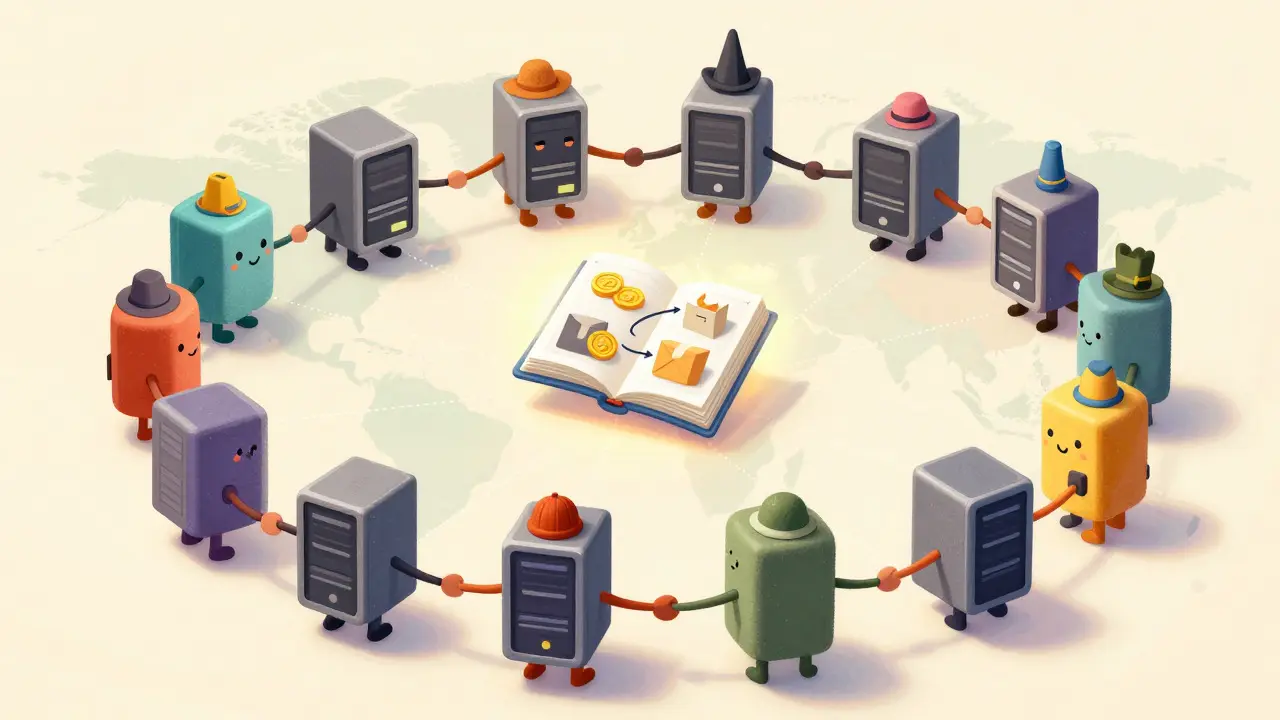
To understand DLT, you first need to visualize the structure. Unlike a traditional database stored on one server in a secure room, a distributed ledger is replicated across many sites, countries, and institutions. Each participant, known as a node, holds an identical copy of the entire history of transactions.
This setup creates a peer-to-peer (P2P) network. When a new transaction occurs, it isn't sent to a central authority for processing. Instead, it is broadcast to all nodes in the network. Each node processes the update independently. Only after they collectively agree on the validity of the transaction is it added to the ledger. This process ensures that no single entity can manipulate the data without the rest of the network noticing and rejecting the change.
The key components here are:
- Nodes: Individual computers running the software that maintain copies of the ledger.
- Peer-to-Peer Network: The communication layer connecting these nodes directly.
- Cryptographic Keys: Digital signatures that prove ownership and authorize transactions.
Consensus Mechanisms: How Trust Is Built
If there is no central administrator, how does the network decide which version of the ledger is correct? This is where consensus mechanisms come in. They are the rules that ensure all nodes agree on the state of the ledger, preventing issues like double-spending (spending the same digital coin twice).
There are several types of consensus algorithms, each with different trade-offs regarding speed, security, and energy consumption.
| Mechanism | How It Works | Pros | Cons |
|---|---|---|---|
| Proof of Work (PoW) | Miners solve complex mathematical puzzles to validate blocks. | Highly secure; battle-tested (used by Bitcoin). | Energy-intensive; slower transaction speeds. |
| Proof of Stake (PoS) | Validators are chosen based on the amount of cryptocurrency they hold and stake. | Energy-efficient; faster finality. | Potential for wealth concentration among large holders. |
| Delegated Proof of Stake (DPoS) | Token holders vote for delegates who validate transactions. | Very fast; scalable. | Less decentralized than PoS or PoW. |
For example, Bitcoin uses Proof of Work to secure its network through computational effort. In contrast, Ethereum transitioned to Proof of Stake to reduce energy consumption while maintaining security. The choice of mechanism depends on the specific goals of the cryptocurrency project.
Blockchain vs. Distributed Ledger Technology
You will often hear "blockchain" and "distributed ledger technology" used interchangeably, but they are not the same thing. Think of DLT as the broad category and blockchain as a specific type within that category.
All blockchains are distributed ledgers, but not all distributed ledgers are blockchains. A blockchain specifically organizes data into "blocks" that are chained together chronologically using cryptography. Each block contains a hash of the previous block, making the history immutable and difficult to alter retroactively.
Other forms of DLT might use Directed Acyclic Graphs (DAGs) instead of blocks. For instance, IOTA uses a Tangle structure, which allows for fee-less microtransactions by having each transaction validate previous ones. Understanding this distinction is crucial when evaluating different crypto projects.

Public vs. Private Networks
Distributed ledgers are also categorized by access control. This determines who can read, write, or audit the ledger.
- Public Permissionless Networks: Anyone can join, validate transactions, and view the data. Bitcoin and Ethereum are examples. These offer the highest level of decentralization and transparency but may face scalability challenges.
- Private Permissioned Networks: Access is restricted to invited participants. Organizations like banks or supply chain consortiums often use these. They offer higher speed and privacy but sacrifice some decentralization since a few entities control entry.
For true cryptocurrency applications, public permissionless networks are preferred because they align with the ethos of financial sovereignty and censorship resistance. However, private DLTs are gaining traction in enterprise sectors for their efficiency.
Security and Immutability
One of the biggest advantages of DLT is security. Because the ledger is distributed, attacking it requires compromising more than 50% of the network's computing power (in PoW) or stake (in PoS). This is economically and computationally prohibitive for large networks like Bitcoin.
Additionally, cryptographic hashing ensures immutability. Once a transaction is confirmed and added to the ledger, changing it would require recalculating the hashes of all subsequent blocks. This makes fraud extremely difficult compared to traditional databases, where administrators can manually edit records.

Real-World Applications Beyond Currency
While cryptocurrency was the first major application, DLT's utility extends far beyond digital cash. Here are some concrete examples:
- Supply Chain Tracking: Companies like Walmart use blockchain to trace food products from farm to store, reducing contamination response times from days to seconds.
- Digital Identity: Governments are exploring DLT for issuing secure, self-sovereign digital IDs that users control.
- Voting Systems: Pilot programs in countries like Estonia use blockchain-based voting to enhance transparency and accessibility.
- Smart Contracts: Automated agreements that execute when conditions are met, used in insurance payouts and real estate transactions.
These applications leverage the same principles of trustlessness and transparency that make cryptocurrency viable.
Challenges and Limitations
Despite its potential, DLT is not a silver bullet. Several challenges remain:
- Scalability: Public blockchains often struggle with high transaction volumes, leading to slow speeds and high fees during peak usage.
- Interoperability: Different blockchains often operate in silos, making it hard to move assets or data between them seamlessly.
- Regulatory Uncertainty: Governments are still figuring out how to regulate decentralized systems, creating legal gray areas.
- User Experience: Managing private keys and understanding wallet security remains a barrier for mainstream adoption.
Developers are actively working on solutions like Layer 2 scaling protocols (e.g., Lightning Network for Bitcoin) and cross-chain bridges to address these issues.
The Future of Distributed Ledgers
As the technology matures, we are seeing a shift towards greater interoperability and user-friendly interfaces. The focus is moving from pure speculation to practical utility. Expect to see more integration of DLT into existing financial infrastructure, such as tokenized real-world assets (real estate, stocks) being traded on-chain.
Furthermore, advancements in zero-knowledge proofs are enhancing privacy without sacrificing transparency, allowing users to verify transactions without revealing sensitive data. This balance is critical for widespread enterprise and consumer adoption.
In summary, Distributed Ledger Technology works by distributing trust across a network of nodes, using consensus mechanisms to validate transactions, and employing cryptography to secure data. Whether you are investing in cryptocurrency or building a decentralized application, understanding these fundamentals is essential.
Is Distributed Ledger Technology the same as Blockchain?
No, blockchain is a specific type of distributed ledger technology. All blockchains are DLTs, but not all DLTs are blockchains. Blockchains organize data into linked blocks, while other DLTs might use different structures like DAGs.
How does a consensus mechanism prevent double-spending?
Consensus mechanisms ensure that all nodes in the network agree on the order and validity of transactions. Before a transaction is finalized, the network verifies that the sender has sufficient funds and hasn't already spent those same coins elsewhere. Once agreed upon, the transaction is recorded immutably.
What is the difference between a public and private DLT?
A public DLT is open to anyone to join and participate, offering high decentralization and transparency (e.g., Bitcoin). A private DLT restricts access to invited participants, offering better performance and privacy but less decentralization (e.g., Hyperledger Fabric).
Why is DLT considered more secure than traditional databases?
Traditional databases have a single point of failure and can be altered by administrators. DLT distributes data across many nodes, so hacking it requires compromising a majority of the network simultaneously. Additionally, cryptographic hashing makes past records nearly impossible to change without detection.
Can DLT be used for things other than cryptocurrency?
Yes, DLT is used in supply chain management, digital identity verification, voting systems, and smart contracts for legal agreements. Its ability to provide transparent, tamper-proof records makes it valuable in many industries.
