
You’ve heard the hype: blockchains are immutable. That’s a fancy word for "you can’t change what’s already written." But why? It’s not magic, and it’s not because a central authority is guarding the ledger with a sword. It’s math. Specifically, it’s cryptographic hashing.
If you’ve ever tried to edit an Excel spreadsheet from last year, you know how easy it is to slip in a new number or delete a row. Nobody stops you. In a blockchain, that same edit triggers a digital alarm so loud and complex that fixing it requires re-doing every single calculation that came after it. This article breaks down exactly how cryptographic hashing creates this unbreakable chain of trust, why SHA-256 is the engine under the hood, and what happens when someone tries to cheat the system.
The Digital Fingerprint: What Is a Hash?
Think of a hash function as a super-efficient blender. You throw in ingredients-data of any size, whether it’s one word or a billion transactions-and out comes a smoothie of a fixed size. No matter how much fruit you add, the cup size stays the same. In crypto terms, this output is called a hash or digest.
For Bitcoin, this process uses SHA-256, which stands for Secure Hash Algorithm 256-bit. Here’s the catch: it’s deterministic. If you put in the exact same data twice, you get the exact same hash every time. But if you change even one comma in the input, the output changes completely. This is known as the avalanche effect.
Why does this matter? Because it turns data into a unique fingerprint. You can’t reverse-engineer the original data from the hash (it’s one-way), and you can’t find two different sets of data that produce the same hash (collision resistance). These properties are the bedrock of blockchain integrity.
Chaining Blocks: The Link That Binds
A blockchain isn’t just a list of blocks; it’s a chain where each link depends on the previous one. How? By including the hash of the previous block inside the current block.
Imagine Block A has a hash of abc123. Block B doesn’t just store its own transactions; it also stores abc123. Now, Block B calculates its own hash based on its transactions and the hash of Block A. Let’s say Block B’s hash becomes def456. Block C then includes def456 in its data.
This structure creates a dependency loop. If a hacker wants to change a transaction in Block A, they have to recalculate Block A’s hash. But changing Block A’s hash means Block B’s stored reference (abc123) is now wrong. So, they must recalculate Block B’s hash. Which breaks Block C. And so on, all the way to the present day.
This is why blockchain immutability isn’t about preventing edits physically-it’s about making them computationally impossible to sustain without rewriting history.

Merkle Trees: Efficiency at Scale
Storing every transaction’s hash individually would be slow. Enter the Merkle Tree, a hierarchical data structure invented by Ralph Merkle.
Instead of listing thousands of transaction hashes, a blockchain groups them. Two transaction hashes are combined to create a parent hash. Those parents are combined to create grandparent hashes, until everything boils down to a single Merkle Root stored in the block header.
| Feature | Linear List | Merkle Tree |
|---|---|---|
| Data Storage | Stores all transaction hashes | Stores only the Root Hash |
| Verification Speed | Slow (must check every item) | Fast (logarithmic time complexity) |
| Proof Size | Grows linearly with transactions | Remains small regardless of volume |
This allows nodes to verify if a specific transaction is in a block without downloading the entire block. They just need the path up the tree to the root. It’s efficient, secure, and essential for scaling networks like Bitcoin and Ethereum.
Proof-of-Work: The Cost of Changing History
Hashing alone makes tampering detectable, but Proof-of-Work (PoW) makes it prohibitively expensive.
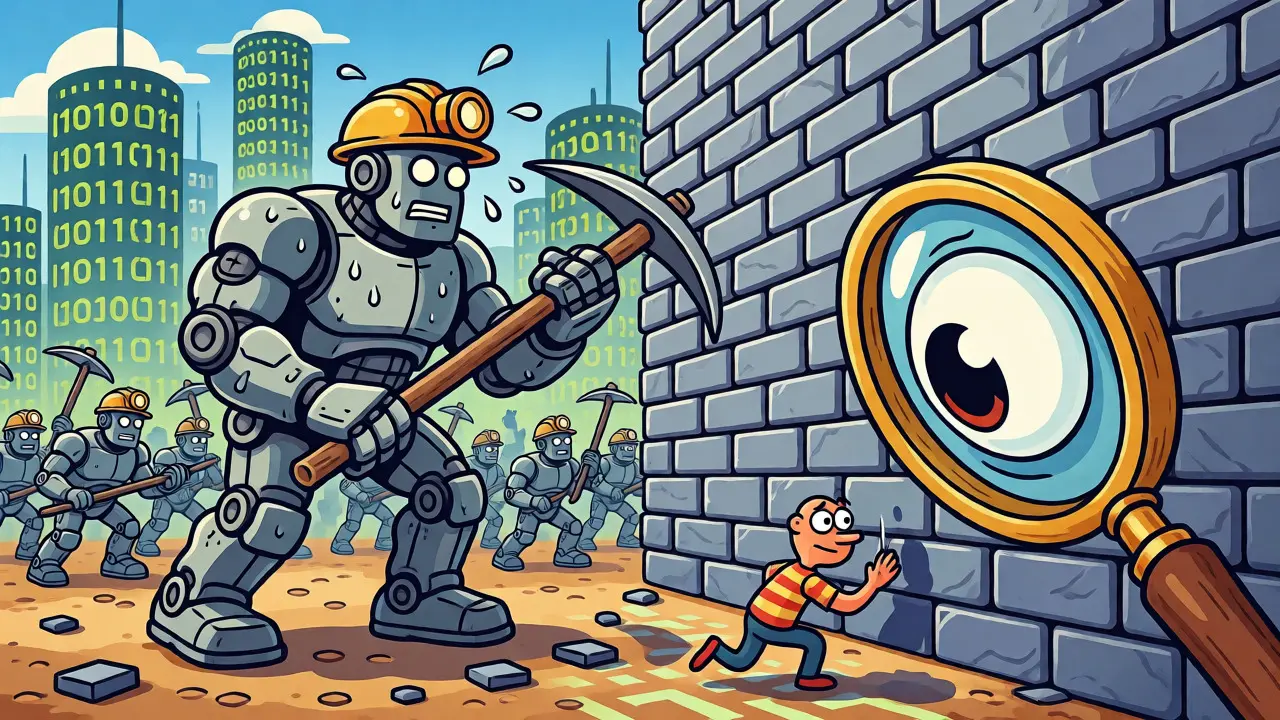
In Bitcoin, miners compete to find a hash that starts with a certain number of zeros. This isn’t random luck; it’s brute-force guessing. On average, a miner might try billions of combinations per second. When someone tries to rewrite history, they don’t just need to fix the hashes-they need to redo the Proof-of-Work for every subsequent block faster than the rest of the network adds new ones.
As of early 2026, the Bitcoin network’s hash rate hovers around 400 exahashes per second. To launch a successful 51% attack (where you control more computing power than everyone else), you’d need hardware costing billions of dollars and electricity bills to match. For major chains, altering a transaction from five years ago is economically irrational. You’d spend more trying to cheat than the value of the coins you’re stealing.
When Immutability Breaks: The 51% Attack
Is immutability absolute? Not quite. It’s probabilistic. Smaller blockchains with less mining power are vulnerable to 51% attacks.
In August 2023, Ethereum Classic suffered a double-spend incident where attackers rewound the chain by hundreds of blocks. Why could they do this? Because their network had significantly lower hash rate than Bitcoin. An attacker rented enough mining power to temporarily outpace the honest nodes, rewrote recent history, and spent coins twice before the network caught up.
This highlights a key nuance: immutability scales with network security. The bigger and more decentralized the network, the harder it is to break the chain. Bitcoin’s 18-year unbroken history since 2009 is the ultimate proof of concept.
Future-Proofing: Quantum Threats and New Standards
Technology moves fast. While SHA-256 is currently secure against classical computers, quantum computing poses a long-term threat. A sufficiently powerful quantum computer could theoretically use Shor’s algorithm to break certain cryptographic functions, though estimates suggest we need millions of stable qubits to threaten SHA-256 directly.
Developers aren’t waiting around. NIST (National Institute of Standards and Technology) has already approved SHA-3 as a supplemental standard. Many enterprise blockchains like Hyperledger Fabric allow pluggable hashing modules, letting companies switch algorithms without overhauling their entire infrastructure. The goal isn’t just to keep data safe today, but to ensure it remains untampered decades from now.
Can I change a transaction after it’s confirmed?
Technically, yes, but practically no. You can modify the data in your local copy, but the network will reject it because the hash won’t match the consensus. To make the change stick globally, you’d need to re-mine every block following the change, which is computationally prohibitive for established chains like Bitcoin.
What happens if two transactions have the same hash?
This is called a collision. With SHA-256, the probability is astronomically low-like winning the lottery twice in a row while being struck by lightning. Cryptographers consider SHA-256 collision-resistant for all practical purposes, meaning we haven’t found two inputs that produce the same output yet.
Does hashing encrypt my data?
No. Hashing is one-way; encryption is two-way. Hashing verifies integrity (did the data change?), while encryption ensures confidentiality (who can read the data?). On public blockchains, transaction details are often visible to everyone, but protected by pseudonymous addresses derived from hashing.
Why do some blockchains use different hash functions?
Different projects prioritize different traits. Bitcoin uses SHA-256 for its proven security. Ethereum originally used Keccak-256 (often confused with SHA-3) to optimize for memory hardness, aiming to resist ASIC mining dominance. Altcoins may choose algorithms based on speed, energy efficiency, or decentralization goals.
Is a private blockchain still immutable?
It depends on governance. Technically, the hashing links prevent silent tampering. However, in permissioned networks (like Hyperledger), a trusted administrator group might agree to fork the chain or reset state. So, while the math prevents accidental corruption, human governance determines true immutability.

20 Comments
Chukwunanu Sunday
October 24, 2026 AT 23:19 PMman this is actually pretty chill reading, i like how u broke down the merkle tree stuff without making it sound like a textbook. good job.
Michael Houghton
October 25, 2026 AT 14:32 PMThe author's reliance on the 'blender' analogy for hashing is frankly pedagogically lazy. It fails to capture the preimage resistance and collision resistance nuances that are critical for any serious cryptographic discussion. Furthermore, conflating SHA-256 with general hash functions ignores the specific structural vulnerabilities of Merkle-Damgård construction which SHA-3 was designed to mitigate. One must also consider that immutability is not an absolute mathematical truth but a probabilistic economic consensus; treating it as a binary state demonstrates a superficial understanding of distributed ledger theory. The mention of quantum threats is similarly underdeveloped, ignoring the fact that Grover's algorithm only provides a quadratic speedup, meaning SHA-256 remains robust against brute force attacks even in a post-quantum era, unlike asymmetric encryption schemes. This article reads like it was written by someone who skimmed the whitepaper rather than engaging with the underlying algebraic structures.
To suggest that 'changing history' requires redoing every calculation oversimplifies the fork choice rule and the longest chain heuristic. A true expert would discuss the Nakamoto consensus and the stochastic nature of block propagation delays. Until we stop dumbing down cryptography for the masses, we will continue to see these half-baked explanations circulating in tech media.
Wayne Smith
October 26, 2026 AT 21:36 PMOh wow, another crypto bro explaining why his imaginary internet money can't be deleted?? Shocking!! Truly revolutionary insights here!!!
Dawn Askew
October 28, 2026 AT 19:15 PMActually, I think you're missing the point entirely. Immutability isn't about math being unbreakable; it's about social coordination. If everyone agrees to change the rules, the chain changes. The math just makes it hard for one person to lie, not impossible for the group to decide. Also, private chains prove that 'immutability' is often just a marketing term for 'we control the database'.
Michael Houghton
October 30, 2026 AT 03:59 AMYour dismissal of cryptographic guarantees in favor of 'social coordination' is precisely why blockchain adoption has stalled in enterprise sectors. You cannot build institutional trust on vibes and committee votes. The deterministic nature of SHA-256 provides an objective layer of verification that subjective governance lacks. When you say private chains prove immutability is a marketing term, you ignore the technical distinction between permissioned access control and cryptographic integrity. They are orthogonal concepts. Confusing them leads to bad architectural decisions where companies assume they need a blockchain when they merely need a shared SQL database with audit logs.
Anshu Raj
October 30, 2026 AT 12:02 PMthey are hiding the real reason its immutable because if we could change it then we would see what the gov really did with our data back in 2009 and nobody wants that truth out there so they keep the math locked tight forever
Dylan Rondeau
November 1, 2026 AT 09:00 AMWhile the conspiracy angle is fun, the technical barrier to entry for rewriting Bitcoin's history is indeed prohibitive due to the energy cost. To rewrite just one year of blocks, you'd need to outpace the entire network's current hash rate, which consumes roughly 150 TWh annually. That's more electricity than many countries use. So yes, it's economically irrational to tamper with recent history, let alone ancient history. The math holds up because the incentive structure aligns with honesty.
Ryan Hall
November 2, 2026 AT 08:55 AMugh another long winded explainer 😒 nobody cares about merkle trees unless ur building a node. just say it cant be changed and move on 🙄
Erin Williams
November 2, 2026 AT 18:29 PMI love how this breaks down the complexity into digestible parts! Understanding the avalanche effect really helps visualize why security works. It’s empowering to know that the system protects itself through simple, elegant logic rather than just trusting a central authority. Great read for anyone trying to grasp the fundamentals!
Jamie Robb
November 4, 2026 AT 08:31 AMwait does this mean if i send btc to my mom and she sends it back to me its still immutable? seems kinda pointless if u can just send it back and forth lol. anyway ty for the info.
mike blogger
November 4, 2026 AT 21:26 PMYes, exactly! Each transaction is a new immutable record. Sending it back creates a new link in the chain. The history remains untouched. Keep learning!
Conor McLaughlin
November 6, 2026 AT 00:04 AMThis is EXACTLY why I left traditional banking! 😤 The sheer audacity of banks changing your balance at midnight without asking! Here, the math doesn't care about your feelings or your manager's mood. It is cold, hard, beautiful truth! 🌟 But seriously, the section on 51% attacks scared me a bit. Are small altcoins basically toys waiting to be broken? 😰 I feel like I'm constantly walking on eggshells with my portfolio.
Raman Tiwari
November 6, 2026 AT 02:48 AMOh, absolutely! Your concern is valid but perhaps overly dramatic regarding major chains. Think of it this way: Ethereum Classic was vulnerable because it had less miners, but Bitcoin is protected by thousands of independent nodes globally. It’s like comparing a village gate to a fortress wall. We should celebrate the diversity of solutions though, right? Some prioritize speed, others security. It’s all part of the grand experiment!
Conor McLaughlin
November 7, 2026 AT 10:40 AMBut what if the fortress falls?! 😱 What if quantum computers break SHA-256 next Tuesday?! I can’t sleep knowing my digital gold might vanish overnight! The uncertainty is killing me! 💔
Brian Klidies
November 8, 2026 AT 11:40 AMIt is reassuring to see such clear explanations. The comparison to Excel spreadsheets resonated with me personally. I have worked in finance for years and the fragility of manual ledgers is a constant stressor. Knowing that the blockchain enforces integrity automatically reduces that cognitive load significantly. Thank you for articulating this so well.
gita wijayanti
November 9, 2026 AT 15:25 PMYou MUST understand that this technology is the future! Do not doubt it! Every single person needs to learn this NOW! Stop wasting time on old systems! Embrace the immutability! It is powerful! It is inevitable! Go research more! Do not stop until you understand every byte!
Jack Denter
November 10, 2026 AT 13:11 PM🇮🇪 In Ireland, we appreciate a good story, and this one about the 'digital fingerprint' is quite poetic! 🍀 It reminds me of how we preserve our oral histories. Once spoken, it's hard to take back. Blockchain does the same for data. Cool concept! 👍
Tony Byrne
November 10, 2026 AT 19:43 PMOh, thank you so much for sharing this!! It really helped clarify things for me... I was struggling with the idea of the 'avalanche effect' before, but now it makes sense!! You are doing such great work educating people... please keep writing articles like this... they are very helpful for beginners like me... !!
Joy Joseph
November 12, 2026 AT 16:38 PMThe exposition of cryptographic principles herein is commendable. However, one must rigorously examine the scalability implications of Proof-of-Work. While immutability is preserved, the latency and throughput constraints remain significant hurdles for global adoption. Future iterations must address these bottlenecks without compromising the foundational security assumptions established by hashing algorithms.
Edington Vernita
November 13, 2026 AT 18:12 PMI appreciate the balanced perspective on private vs public chains. It is important to respect that different use cases require different levels of decentralization. Not every organization needs full immutability; some just need transparency. Both approaches have their place in the ecosystem.