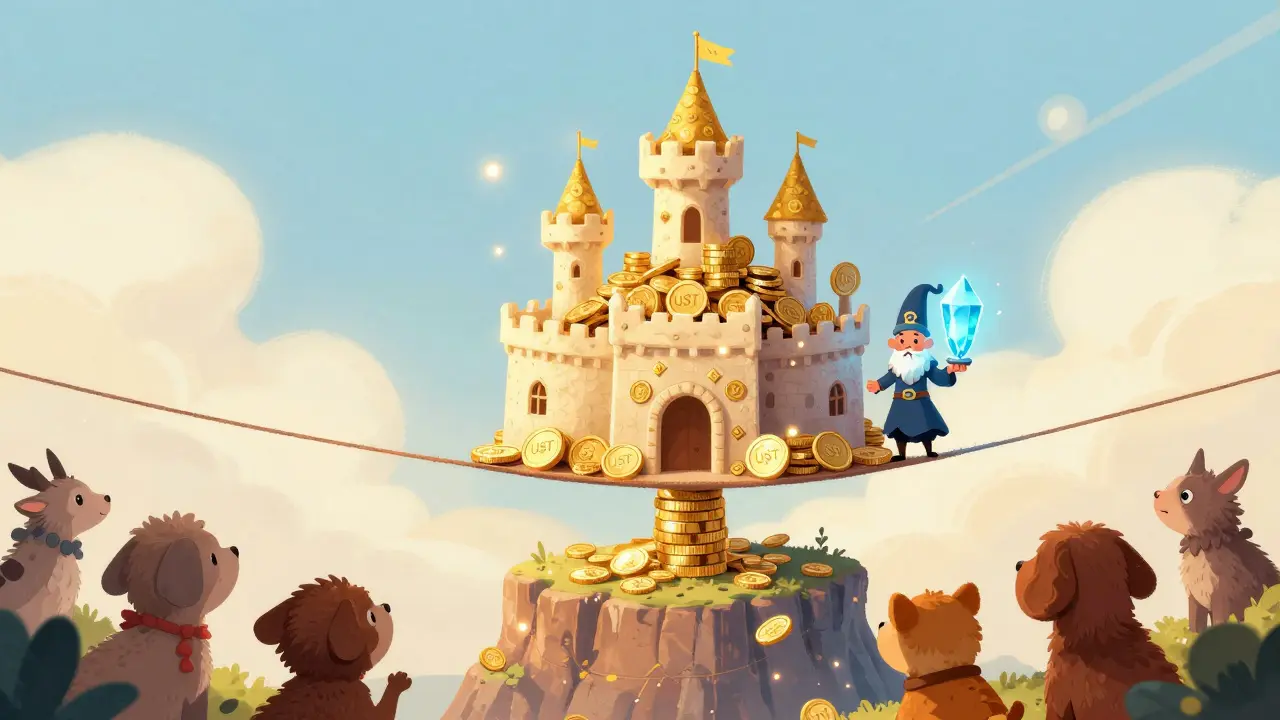
When people ask "What is Terra (LUNA)?", they’re not just asking about a crypto coin-they’re asking about one of the biggest collapses in blockchain history, and the strange, controversial resurrection that followed. The answer isn’t simple. There are two Terra tokens now. One is a ghost. The other is a rebuild. And both carry the weight of a $40 billion crash that wiped out fortunes overnight.
The Original Terra: How UST and LUNA Were Supposed to Work
The original Terra network launched in 2019 with a bold idea: create a stablecoin that didn’t need cash reserves. Its flagship token, UST (TerraUSD), promised to stay worth exactly $1. It wasn’t backed by dollars in a bank. Instead, it used a clever algorithm tied to LUNA, the network’s native token.
Here’s how it was meant to work: if UST dropped below $1, you could burn $1 worth of LUNA to mint 1 UST. If UST rose above $1, you could burn 1 UST to get $1 worth of LUNA. This back-and-forth was supposed to keep UST pegged. And for over two years, it worked. UST became the third-largest stablecoin in the world, with over $18 billion in circulation.
LUNA, meanwhile, was a volatile token. Its price swung wildly as people bought and burned it to stabilize UST. But that volatility wasn’t a bug-it was the feature. LUNA absorbed all the pressure. It was the shock absorber. And for a while, everyone believed it could handle the load.
The Collapse: When the Algorithm Broke
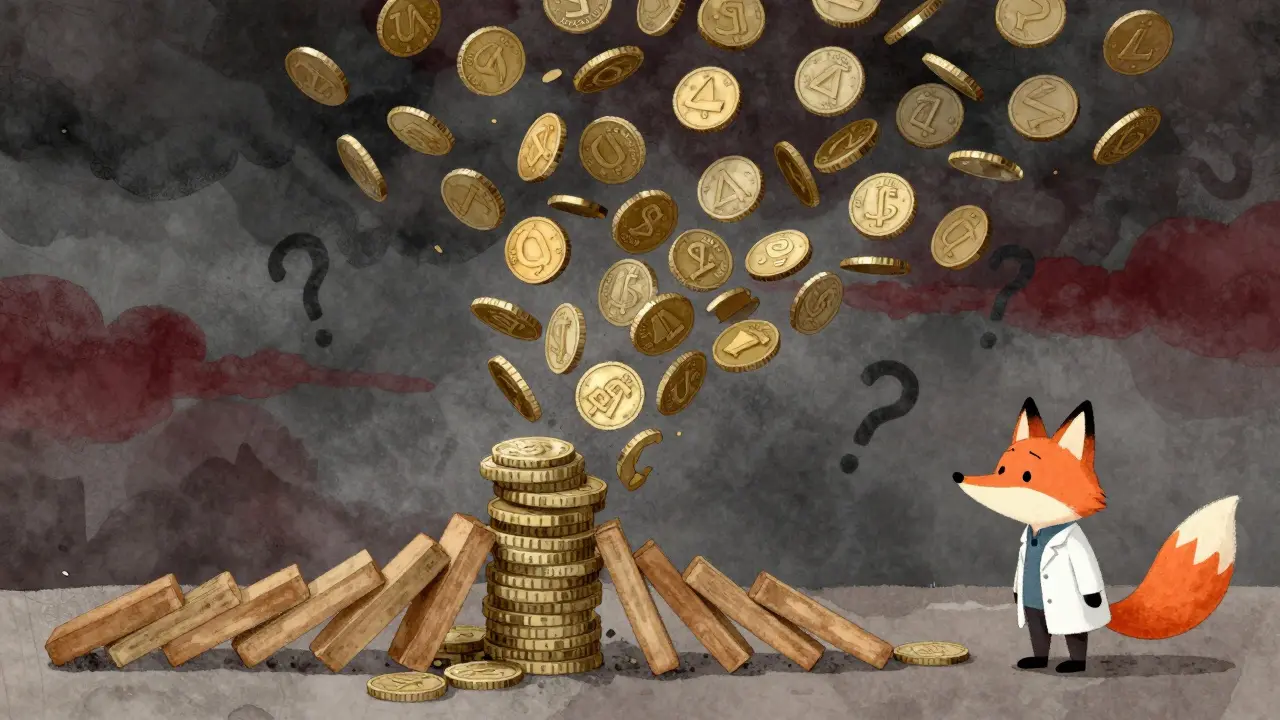
On May 7, 2022, everything unraveled. A large sell-off of UST triggered a panic. People started redeeming UST for LUNA faster than the system could handle. LUNA’s price crashed. More people panicked. More UST was burned. More LUNA was minted. The supply of LUNA exploded from 350 million to over 6.5 trillion tokens in days.
The result? UST lost its peg. It dropped to 80 cents. Then 60 cents. Then 10 cents. LUNA went from $80 to $0.0001. The entire ecosystem evaporated. $40 billion in market value disappeared in less than a week. Investors, exchanges, and even institutional funds were left holding worthless tokens. The crash wasn’t just a market dip-it was a systemic failure. And it wasn’t caused by hackers. It was caused by a flawed design.
Terra 2.0: The Rebirth
Just weeks after the collapse, the Terra community voted to hard fork the blockchain. On May 28, 2022, Terra 2.0 was born. It kept the name LUNA, but everything else changed. The algorithmic stablecoin-UST-was gone. No more burning, no more minting, no more fragile math.
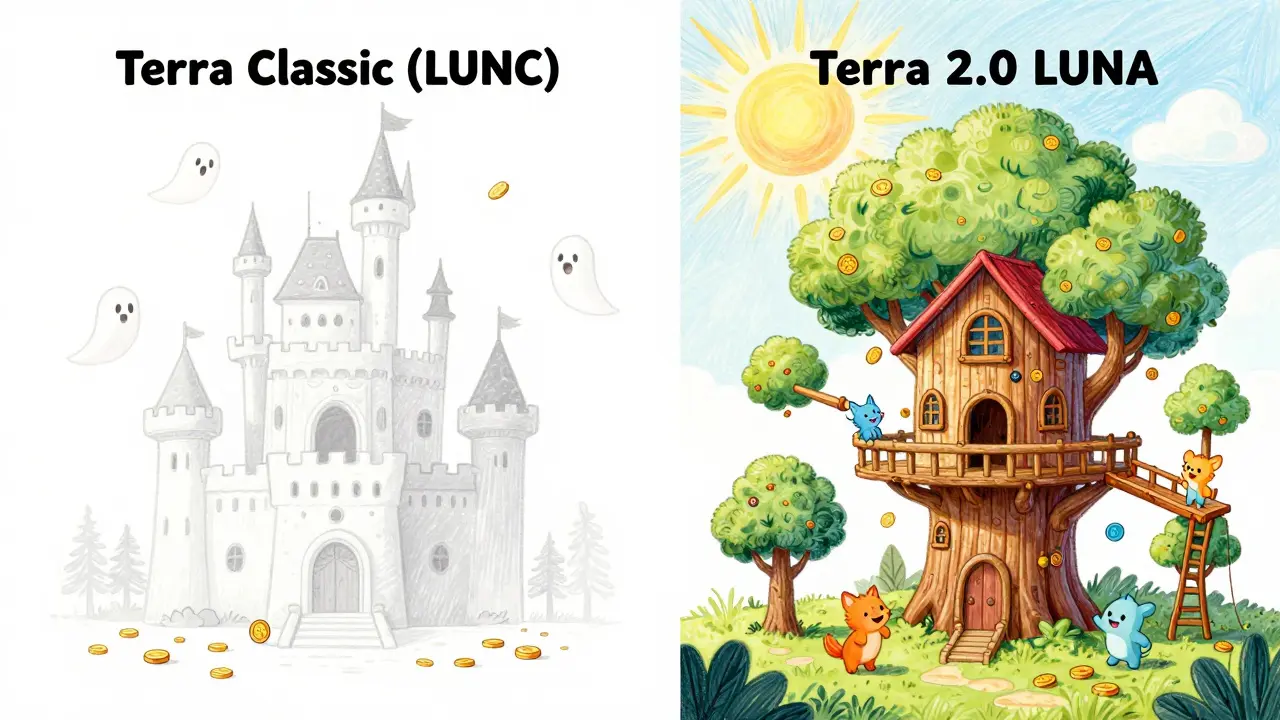
Terra 2.0’s LUNA is now a pure governance and staking token. It runs on a modified Cosmos SDK, connects to other blockchains via IBC, and supports DeFi apps, NFTs, and smart contracts. Think of it less as a stablecoin engine and more like a smaller, leaner version of Ethereum or Solana.
As of May 2025, Terra 2.0’s LUNA trades around $0.22. It’s up from its post-crash low of $0.003, but still only 3.6% of its all-time high. Its market cap sits at about $1 billion-tiny compared to Ethereum’s $400 billion, but a far cry from the ashes of the original.
Terra Classic (LUNC): The Original Chain Lives On
While Terra 2.0 was being built, the old chain didn’t disappear. It became Terra Classic, with its token renamed LUNC (Luna Classic). It’s still active. Still tradable. Still used by a small group of believers who think the original vision can be revived.
But the numbers tell a different story. LUNC has a circulating supply of over 6.4 trillion tokens. Its price? Around $0.00006. That’s a market cap of $325 million. The token is so oversupplied that even a 10x price jump wouldn’t make it valuable in the same way as LUNA. It’s a relic. A cautionary tale. And for many, a painful reminder of what they lost.
Who’s Still Using Terra 2.0?
Despite the trauma, Terra 2.0 isn’t dead. Wallet addresses have grown from 42,000 in January 2024 to over 318,000 in May 2025. That’s a 657% increase-faster than the overall crypto market. The Discord community has ballooned from 12,700 to 84,300 members. Developers are slowly coming back.
The upcoming "Aurora" upgrade in Q3 2025 will add EVM compatibility, meaning Ethereum-based apps can move over. The "Nexus" upgrade in Q1 2026 aims to boost transaction speed to 5,000 TPS. That’s still far behind Solana’s 65,000 TPS, but it’s a step forward.
Still, adoption is thin. Only 17 businesses use Terra 2.0’s blockchain as of May 2025. Compare that to Ethereum’s 1,240. Most developers still choose safer chains. The trust isn’t there.
Is Terra 2.0 a Scam? The Do Kwon Shadow
Do Kwon, the founder of Terraform Labs, was arrested in March 2023 by Interpol. He’s now facing fraud charges in the U.S. and South Korea. His name is tied to the original collapse. And yet, he’s still publicly involved in Terra 2.0’s development.
That’s the biggest hurdle. Many call Terra 2.0 a "rebranding scam." They argue Kwon simply renamed the old chain and stole the name. Reddit threads are full of users who lost $50,000 or more. One user wrote: "I lost $87,000. I’m watching, but I won’t touch it until LUNA hits $1 and stays there for six months."
Trustpilot reviews for Terra-related services average just 2.3 out of 5. The most common complaint? "History of collapse."
But others see a second chance. The GENIUS Act of January 2025 banned unbacked algorithmic stablecoins-exactly the kind Terra 1.0 used. That law, ironically, protects Terra 2.0. It’s now one of the few chains without that dangerous feature.
Price Predictions: Optimism vs. Skepticism
Opinions on Terra 2.0’s future are wildly split.
OKX Learn predicts LUNA could hit $0.95 by 2025, $1.67 by 2027, and $3.75 by 2030. GATE.com forecasts $1.59 by December 2025 under bullish conditions. But CoinCodex says LUNA will drop to $0.07 by November 2025. GODEX.io gives a range: $0.33 to $1.59.
The truth? No one knows. The market is still reacting to trauma. LUNA’s price swings are less about fundamentals and more about sentiment. Will the community rebuild? Or will it stay scarred?
Should You Buy LUNA?
If you’re thinking about buying Terra 2.0’s LUNA, here’s what you need to know:
- It’s high risk. This isn’t Bitcoin or Ethereum. This is a chain that died and came back. The trust is fragile.
- It’s not a stablecoin anymore. Don’t buy LUNA thinking it’ll hold value like USDT. It’s a speculative asset.
- Check the upgrades. The Aurora and Nexus upgrades could change everything-if they ship on time.
- Don’t invest more than you can lose. If you lost money in 2022, ask yourself: are you investing, or are you trying to recover?
For most people, Terra 2.0 is not a core holding. But for those who believe in second chances-and understand the risks-it’s one of the most fascinating experiments in crypto history.
What’s Next for Terra?
The next 12 months will decide Terra 2.0’s fate.
If the Aurora upgrade brings real Ethereum dApps over, and if wallet growth keeps climbing, Terra might become a niche player in DeFi. If the upgrades are delayed, if developers keep leaving, and if the community stays divided, Terra 2.0 could fade into obscurity.
One thing’s certain: Terra will never be the same. The old LUNA is dead. The new one is still learning how to walk.
Is Terra (LUNA) the same as Terra Classic (LUNC)?
No. Terra Classic (LUNC) is the original blockchain that collapsed in May 2022. Terra 2.0 (LUNA) is a completely new blockchain launched after the crash. They have different tokens, different supply, different values, and different purposes. LUNA is a governance token. LUNC is a relic with no stablecoin mechanism.
Why did UST lose its peg?
UST lost its peg because a large sell-off triggered a feedback loop. As people sold UST, they burned LUNA to mint more UST, flooding the market with LUNA. That crashed LUNA’s price, which made the algorithm unable to stabilize UST. The system had no safety net-no reserves, no backup. When confidence broke, the whole thing collapsed.
Can Terra 2.0 succeed without UST?
Yes, but it’s not easy. Terra 2.0 has removed the unstable algorithmic stablecoin and now focuses on DeFi, NFTs, and smart contracts. Its success depends on attracting developers, getting major exchanges to support it fully, and delivering on its Aurora and Nexus upgrades. Without those, it’s just another low-cap altcoin.
Is it safe to stake LUNA on Terra 2.0?
Staking LUNA is technically safe from a smart contract standpoint. The network has been stable since Q1 2024. But there’s reputational risk. If the project fails again, your staked tokens could lose value. Always use a trusted wallet like Keplr, and never stake more than you’re willing to lose.
What happened to Do Kwon?
Do Kwon was arrested by Interpol in March 2023 and is currently facing criminal fraud charges in the U.S. and South Korea. He’s accused of misleading investors about UST’s stability. Although he’s still involved in Terra 2.0’s development, many in the crypto community view him as a central figure in the collapse.
Where can I buy LUNA (Terra 2.0)?
LUNA (Terra 2.0) is listed on major exchanges including Binance, Coinbase, OKX, and Gate.io. You can trade it for BTC, ETH, USDT, or fiat. Always verify you’re buying the correct token-LUNA (Terra 2.0) has a market cap around $1 billion. LUNC (Terra Classic) has a market cap of $325 million and a supply of 6.4 trillion tokens.

16 Comments
Madhavi Shyam
December 17, 2025 AT 01:10 AMLUNA 2.0 is just a rebranded corpse with EVM aspirations. The algorithm was the core - removing UST doesn’t fix the hubris. They’re building a house on a graveyard and calling it innovation.
Mark Cook
December 18, 2025 AT 03:40 AMlol at people still betting on this 💩🚀
Jack Daniels
December 18, 2025 AT 07:00 AMI still wake up in a cold sweat thinking about my $68k in LUNC. I don’t sleep. I just stare at the charts. It’s not about money anymore. It’s about the ghost in the machine.
Bradley Cassidy
December 18, 2025 AT 18:12 PMman i just wanna believe in second chances 😔 the way terra 2.0’s community’s growing - 300k+ wallets?! that’s not nothing. sure, it’s messy, chaotic, kinda broken… but hey, so was bitcoin in 2013. i’m staking my last 200 LUNA and praying the aurora upgrade doesn’t ghost us like do kwon’s ex-girlfriend.
Craig Nikonov
December 20, 2025 AT 07:32 AMThey didn’t just crash - they were engineered to crash. The whole UST-LUNA model was a Ponzi with math. And now? Terra 2.0 is a Trojan horse. Kwon’s still pulling strings from his prison cell. The ‘upgrades’? PR stunts to lure in new suckers. The GENIUS Act didn’t save them - it just made them look less stupid.
Cheyenne Cotter
December 20, 2025 AT 19:31 PMLet’s be real - Terra 2.0 is surviving on hope and Discord hype. The numbers look good on paper - 657% wallet growth, 84k Discord members - but where are the real users? Where are the dApps that aren’t just clones of Uniswap with a Terra logo? I’ve checked 17 businesses using it. 14 are token-gated merch stores. One is a crypto meme generator. One is a charity that accepts LUNA because they don’t know the difference between it and LUNC. This isn’t a blockchain revival. It’s a digital haunted house with a whitepaper.
And don’t get me started on the ‘Nexus’ upgrade. 5,000 TPS? That’s slower than my home Wi-Fi during Zoom calls. Solana does 65k. Ethereum L2s do 20k. Terra 2.0 is trying to sprint with ankle weights made of regret.
People say ‘trust is fragile’ - no, trust is dead. The only thing growing here is the supply of LUNC, which now has more tokens than there are grains of sand on Earth. And yet, somehow, people still buy it. Why? Because they think ‘this time it’s different.’ Spoiler: it’s not. The algorithm didn’t fail. The people behind it did. And they’re still here.
I’m not saying Terra 2.0 is evil. I’m saying it’s a monument to human stubbornness. We don’t learn from collapse. We just rename it and sell it again.
And if you’re thinking of staking? Fine. But don’t call it investing. Call it emotional maintenance. You’re not betting on code. You’re betting on whether the community can forgive itself.
Emma Sherwood
December 22, 2025 AT 00:28 AMHey, I know it’s hard to trust after what happened - I lost everything too. But I’ve been watching Terra 2.0 for a year now. The devs are quiet, but they show up. They answer questions. They’re not hiding. And the community? It’s full of people who’ve been burned, but still care. That’s rare. I don’t see this as a gamble - I see it as a healing project. We’re not just buying tokens. We’re rebuilding something broken, together. Maybe it’s naive. But sometimes, you gotta choose hope over fear.
Patricia Amarante
December 22, 2025 AT 14:35 PMJust bought my first LUNA today. Not because I think it’ll hit $1, but because I needed to feel like I wasn’t completely powerless after 2022. Small step.
Timothy Slazyk
December 23, 2025 AT 07:23 AMWhat’s fascinating isn’t the collapse - it’s the philosophical void it left. Terra 1.0 promised financial autonomy through code. It failed because it assumed rational actors. But humans aren’t rational. We panic. We FOMO. We chase ghosts. Terra 2.0 isn’t trying to fix the algorithm - it’s trying to fix the human condition. Can a blockchain hold collective trauma? Maybe not. But it can hold memory. And maybe that’s enough.
Donna Goines
December 23, 2025 AT 17:57 PMThey’re all being watched. Every wallet, every trade - it’s all tied to the Fed’s blockchain surveillance program. Terra 2.0 is a honeypot. They let it rise so they can track the ‘crypto radicals’ who still believe. The ‘upgrades’? Just more data collection. You think Kwon’s in prison? He’s in a CIA basement running this whole thing. LUNA’s price is being manipulated to flush out dissenters.
Shruti Sinha
December 24, 2025 AT 00:04 AMLUNC supply is 6.4 trillion. That’s more than the number of stars in the Milky Way. Price won’t matter until burn mechanism returns. Until then, it’s digital confetti.
Kelsey Stephens
December 25, 2025 AT 05:46 AMIt’s okay to be scared. I was too. But if you’re reading this, you’re still here. That means you care. That’s more than most. Don’t rush. Don’t gamble. Just watch. Learn. Maybe one day, you’ll feel ready again.
Tom Joyner
December 25, 2025 AT 14:13 PMTerra 2.0? How quaint. It’s a low-cap altcoin with a nostalgic fanbase. The ‘community’ is just a cult of personality wrapped in a Cosmos SDK. I’d rather stake my time in a Solana memecoin than this post-apocalyptic relic.
Abby Daguindal
December 27, 2025 AT 02:06 AMAnyone who still believes in Terra 2.0 is either delusional or a shill. Do Kwon’s fingerprints are all over this. You think they’d let him out of prison to rebuild his empire? Nah. He’s still running it from behind bars. This isn’t a comeback - it’s a sequel written by a convicted fraudster. Don’t be the next victim.
SeTSUnA Kevin
December 27, 2025 AT 07:40 AMTerra 2.0’s market cap is $1B. Ethereum’s is $400B. The math is trivial. This isn’t a blockchain - it’s a footnote.
Florence Maail
December 27, 2025 AT 19:33 PMThey’re lying about the Aurora upgrade. It’s not coming in Q3. It’s already delayed - I’ve got screenshots from the dev Discord. They’re just buying time so the LUNA pumpers can cash out. And the ‘84k Discord members’? Half are bots. Half are bots pretending to be real people pretending to be bots. This whole thing is a deepfake economy. 🤖💸